
New Jersey Has Superior Court, Not District Court
Many states use a court called "District Court" as their main trial court. New Jersey does not. The New Jersey Constitution, Article VI vests judicial power in the Supreme Court, the Superior Court, and courts of limited jurisdiction. There is no county-level district court anywhere in New Jersey. If you are looking for what other states call a district court, the Ocean County Superior Court is the right place. It handles civil lawsuits, criminal prosecutions, family matters, and equity cases that would go to a district court in Alabama, Texas, or Colorado.
The Superior Court is a single statewide court that operates through 15 vicinages, each serving one or more counties. Ocean County is Vicinage 14. That number, along with county code 15, shows up inside docket numbers for cases filed here. So when someone says to check the district court for Ocean County, they mean the Superior Court. There is no other trial court option for the case types that district courts normally handle.
The Superior Court, Appellate Division (a term defined below) handles appeals from the trial divisions. Cases that cannot be settled at that level may go to the New Jersey Supreme Court. Below the Superior Court, Municipal Courts handle traffic, parking, local ordinance, and disorderly persons matters. They are limited-jurisdiction courts, not district courts, and they have their own separate record systems. The phrase "district court" fits none of those courts either.
Note: Researchers looking for federal district court cases should use the U.S. District Court for the District of New Jersey, a separate federal court entirely, not an Ocean County Superior Court.
Ocean County Superior Court Divisions
The Ocean County Superior Court runs several divisions and parts under one court system at the Justice Complex in Toms River. Each division has its own phone extension, its own manager or administrator, and its own caseload. Civil cases split by dollar amount. Equity and foreclosure cases go to General Equity. Family matters have their own part. Criminal cases go to the Law Division for indictable offenses, which means felony-level charges under New Jersey law.
The table below lists the main divisions and parts of Ocean Vicinage 14, along with phone and extension information from the NJ Courts Ocean Superior Court offices page. All extensions reach the main courthouse line at 732-504-0700. The NJ Courts court system page describes how the statewide court structure connects to these local divisions.
| Court / Division | Phone / Extension | Notes |
|---|---|---|
| Ocean Superior Court / Vicinage 14 (main) | 732-504-0700 | Primary county Superior Court; 118 Washington St and 120 Hooper Ave, Toms River. |
| Trial Court Administration | 732-504-0700 ext. 64330 | Trial Court Administrator Jill Vito; general court administration. |
| Ombudsman | 732-504-0700 ext. 64480 | Public navigation help; accommodations and access assistance. |
| Civil Division (main line) | 732-504-0700 ext. 64360 | Civil cases over $20,000; also routes landlord-tenant inquiries. |
| Civil Division Manager | 732-504-0700 ext. 64340 | Civil Division Manager Jillian Ackermann. |
| General Equity | 732-504-0700 ext. 64380 | Foreclosures, trade-secret disputes, emergency injunctive relief; Chancery Division. |
| Special Civil Part | 732-504-0700 ext. 64340 | Cases over $5,000 up to $20,000; small claims at $5,000 or below. |
| Landlord Tenant | 732-504-0700 ext. 64360 | Summary landlord-tenant matters; evictions and related filings. |
| Law Division | 732-504-0700 ext. 64370 | Civil law cases and all trial functions for the Law Division. |
| Mediation / Arbitration | 732-504-0700 ext. 64390 | Alternative dispute resolution; civil and family program support. |
| Ocean County Surrogate's Court | 732-929-2011 | 118 Washington St, 2nd Floor, Room 216; probate, administration, guardianship, adoptions. |
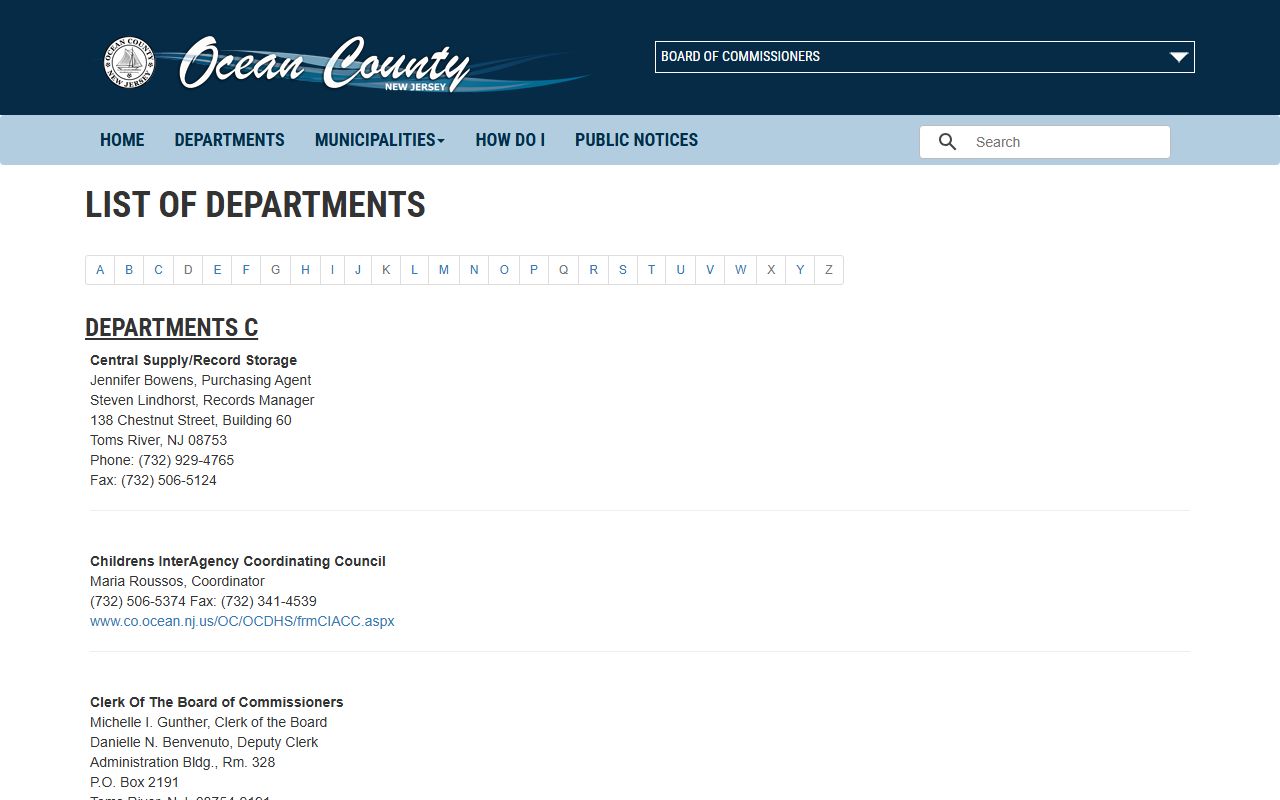
The county's official department directory at co.ocean.nj.us lists Superior Court contacts alongside other Ocean County offices. The screenshot below, from that page, shows how the county presents court and department contact information in one place.
If you are not sure which division handles your matter, start with the main courthouse line at 732-504-0700. Staff can route you to the correct extension.
How a Case Moves Through the System
Cases in Ocean County begin at different entry points depending on the claim or offense. A minor traffic ticket starts in Municipal Court and may never leave that level. A felony charge, called an indictable offense in New Jersey, starts with an arrest and a first appearance, then moves into the Criminal Division of the Superior Court after indictment by a grand jury or by accusation. A civil lawsuit starts when a complaint is filed in the correct division based on the dollar amount.
The path a case takes from start to finish is the case flow. For Ocean County, the standard flow is:
Municipal Court › Superior Court trial divisions (Law Division / Chancery Division / Family Part) › Superior Court, Appellate Division › Supreme Court of New Jersey
Not every case reaches each step. Most end at the trial level. Appeals go to the Appellate Division only when a party believes the trial court made a legal error. The Appellate Division is the intermediate appellate court for the statewide Superior Court. It reviews the record; it does not hold a new trial or hear new witnesses. The Supreme Court of New Jersey takes only a small share of cases, usually those with statewide legal significance. Litigants must petition for certification, and the court grants it at its own discretion.
- Matter begins at Municipal Court (traffic, parking, ordinance) or in Superior Court when a civil complaint is filed or a criminal arrest and first appearance occurs.
- Case is assigned to the correct Superior Court division based on case type and dollar amount claimed.
- Pre-trial motions, discovery, and hearings take place in the assigned division.
- Trial or final resolution occurs; judgment or sentence is entered at the division level.
- If appealed, the case moves to the Superior Court, Appellate Division.
- In rare qualifying cases, the New Jersey Supreme Court may grant certification for review.
Records from each stage are kept by the division or court where the matter was heard. Closed and archived files go through the Superior Court Clerk's Office. See the Superior Court Clerk page for how to request copies of filed records.
Civil, Criminal, Family, and Equity Cases
The Ocean County Superior Court handles a wide range of case types across its divisions. Each division has its own rules, thresholds, and procedures. Civil cases split by the amount in dispute. Criminal cases split by severity. Family matters run through their own part with limited public access rules. Equity cases cover a broad mix of non-jury matters including foreclosures and injunctions.
Civil Division cases are lawsuits where a plaintiff seeks money over $20,000. Common types include car accidents, medical malpractice, contract disputes, and certain landlord-tenant actions. The Special Civil Part handles claims over $5,000 and up to $20,000. Small claims, capping at $5,000, also sit in the Special Civil Part. The Landlord Tenant section handles summary eviction and possession matters. Docket prefixes for these cases include L for Law Division civil, LT for landlord-tenant, DC for Special Civil, and SC for small claims. Ocean County's NJ Courts county code is 15, and it appears embedded in many docket numbers for cases filed here.
The Criminal Division processes indictable adult criminal cases. These are felony-level matters under New Jersey law. The division handles adult first appearances after indictment or complaint, pretrial proceedings, pleas, trials, sentences, and post-conviction motions. Typical documents include complaint-warrants, indictments, accusations, plea forms, motions, judgments of conviction, and sentencing orders. Ocean County Prosecutor Bradley D. Billhimer's office handles prosecution at ocponj.gov. Criminal Division records are public under Court Rule 1:38, with specific exclusions for grand jury materials, sealed warrants, expunged records, and protected victim information.
The Family Part handles divorce (called dissolution), custody, parenting time, child support, domestic violence, juvenile matters, and adoption. Access is limited. NJ Courts states divorce documents are released only to a party or attorney of record unless a court order says otherwise. Adoption records are fully sealed under N.J.S.A. 9:3-51. For dissolution and family records, see the marriage and divorce records page. Probate, estate, and guardianship matters handled by the Chancery Division's Probate Part and the elected Surrogate are covered on the Surrogate's Court page.
General Equity is the Chancery Division section that hears non-jury cases. Foreclosures, trade-secret disputes, labor matters, and emergency injunctive relief all fall under General Equity. Statewide judgment lien records and foreclosure record requests go to the Superior Court Clerk's Office, not to the county division office directly.
Civil Dollar Thresholds at Ocean County Superior Court
Civil Division: claims over $20,000. Special Civil Part: claims over $5,000 through $20,000. Small Claims (within the Special Civil Part): $5,000 or below. Filing in the wrong part can result in transfer or dismissal of the case.
Ocean County Superior Court vs Municipal Court
People often confuse the Superior Court with Municipal Court. They are separate courts with different case types, different record systems, and different appeal paths. Knowing which court handled a matter tells you exactly where its records live and how to get them. The table below compares them side by side on the points that matter most when searching for records.
| Feature | Ocean County Superior Court | Municipal Court |
|---|---|---|
| Case types | Civil over $5,000; indictable criminal; family (divorce, custody, domestic violence); general equity; probate | Traffic tickets; parking violations; local ordinances; disorderly persons; petty disorderly persons |
| Jurisdiction | Countywide; statewide for certain judgment and equity matters | Local; limited to the municipality or shared-services court area |
| Appeals path | Appeals go to the Superior Court, Appellate Division, then New Jersey Supreme Court | Appeals go to the Superior Court, Law Division, then Appellate Division if further review is sought |
| Where records go | Case files held by the Superior Court division; closed files at the Superior Court Clerk's Office (SCCO) | Records held by the specific Municipal Court where the matter was heard; no central county municipal archive |
| Online search tool | NJ Courts Civil Case Jacket portal; criminal public access portal (PGPA) | NJMCDirect; Municipal Court Case Search (MPA portal) |
| Record requests | NJ Courts records request form; JEDS submission; closed files directed to SCCO | Written request to the specific Municipal Court where the case was heard |
The key takeaway is that a Municipal Court record and a Superior Court record live in completely different systems. If you search the civil or criminal portal and find nothing, the case may be a municipal matter instead. Traffic records are the most common example of this confusion. See the traffic court records page for how to search municipal traffic matters in Ocean County.
Municipal Courts in Ocean County
Ocean County has many municipal courts. They operate at the local level and handle matters that do not rise to the Superior Court level. New Jersey courts statewide resolve close to six million municipal cases per year. Most of those are traffic and parking matters, but municipal courts also handle disorderly persons offenses and local ordinance violations. Each municipal court ties to a specific municipality or a group of municipalities that have joined together for shared court services.
Two municipal courts with confirmed state directory information for Ocean County are listed below. For the complete list of every Ocean County municipal court, court code, address, and judge, consult the official state directory linked from the NJ Courts Municipal Court page.
- Ocean Gate Municipal Court (court code 1521): 801 Ocean Gate Ave, Ocean Gate, NJ 08740; phone 732-269-3166. Office hours Monday, Wednesday, and Friday, 9 a.m. to 11 a.m. per the state directory.
- Ocean Township Municipal Court (court code 1520): 50 Railroad Ave, Waretown, NJ 08758; phone 609-693-3332.
Municipal court records do not appear in the Superior Court's Civil Case Jacket or criminal public access portals. To search or request records from a municipal court, contact the specific municipal court where the case was heard. For tickets and complaints, the statewide NJMCDirect tool allows users to pay, plead not guilty, or request a plea agreement from the municipal prosecutor for eligible matters. The Municipal Court Case Search portal helps locate a ticket or complaint number when one is not on hand.
Note: Municipal courts are limited-jurisdiction courts. They cannot hear felony-level indictable cases or civil cases over the small-claims threshold. Those matters belong in the Superior Court.
Appeals to the Appellate Division and Supreme Court
When a party believes the Ocean County Superior Court made a legal error, they may appeal. Appeals from the trial divisions go to the Superior Court, Appellate Division (appellate means relating to the review of lower court decisions). The Appellate Division is a statewide intermediate court. It reviews the record from the trial court; it does not hold a new trial or hear new witnesses. The Appellate Division can affirm, reverse, modify, or remand the decision back to the trial court for further action.
If the Appellate Division rules against a party, further review is possible but not guaranteed. The New Jersey Supreme Court takes only a small share of cases, generally those raising statewide legal questions. Litigants must petition for certification, and the Supreme Court grants it as a matter of discretion. Most appeals end at the Appellate Division level without going further.
Municipal Court appeals follow a shorter path first. A party unhappy with a Municipal Court decision can appeal to the Superior Court, Law Division. If that appeal also fails, further review goes to the Appellate Division. So in practice a traffic case could travel from Municipal Court through the Law Division to the Appellate Division before reaching a final resolution.
Tax Court and Federal Court Distinction
Two other courts sometimes get confused with the Ocean County Superior Court. They are the New Jersey Tax Court and the U.S. District Court for the District of New Jersey. Both are separate from the Superior Court and require different search tools and different request procedures.
The Tax Court of New Jersey is a statewide court that hears appeals from county boards of taxation and decisions of the Division of Taxation. Property owners who dispute their assessment go through their county board first, then to Tax Court if not resolved. The Ocean County Board of Taxation sits at the courthouse west wing, room 215. Tax Court cases are not part of the Superior Court docket and are not searched through the Civil Case Jacket portal.
Federal court cases are entirely separate. Ocean County falls within the U.S. District Court for the District of New Jersey, which covers all 21 New Jersey counties as a single federal district. Federal cases include federal crimes, civil-rights suits, federal-question matters, large diversity cases, bankruptcy, and Social Security appeals. Search them through PACER at pacer.uscourts.gov. PACER charges $0.10 per page, with fees waived if your quarterly total does not exceed $30. The U.S. Bankruptcy Court for the District of New Jersey handles all bankruptcy filings in the state and is also separate from the Ocean County Surrogate's probate jurisdiction.
Ocean County Superior Court Location and Contacts
The Ocean County courthouse campus includes the historic 1850 courthouse at 118 Washington Street and the Justice Complex at 120 Hooper Avenue, both in downtown Toms River. The Justice Complex houses 25 Superior Court judges, several courtrooms, and the administrative offices for each division. The County Clerk and Surrogate maintain offices within the same complex. Security officers staff entry screening at each secure building, so plan for extra time. Audio and video recording devices are restricted for the general public unless official media access has been processed and approved.
The screenshot below comes from the Ocean County Cultural and Heritage page, which documents the historic courthouse that still stands at the center of the county seat and remains part of the active court campus.
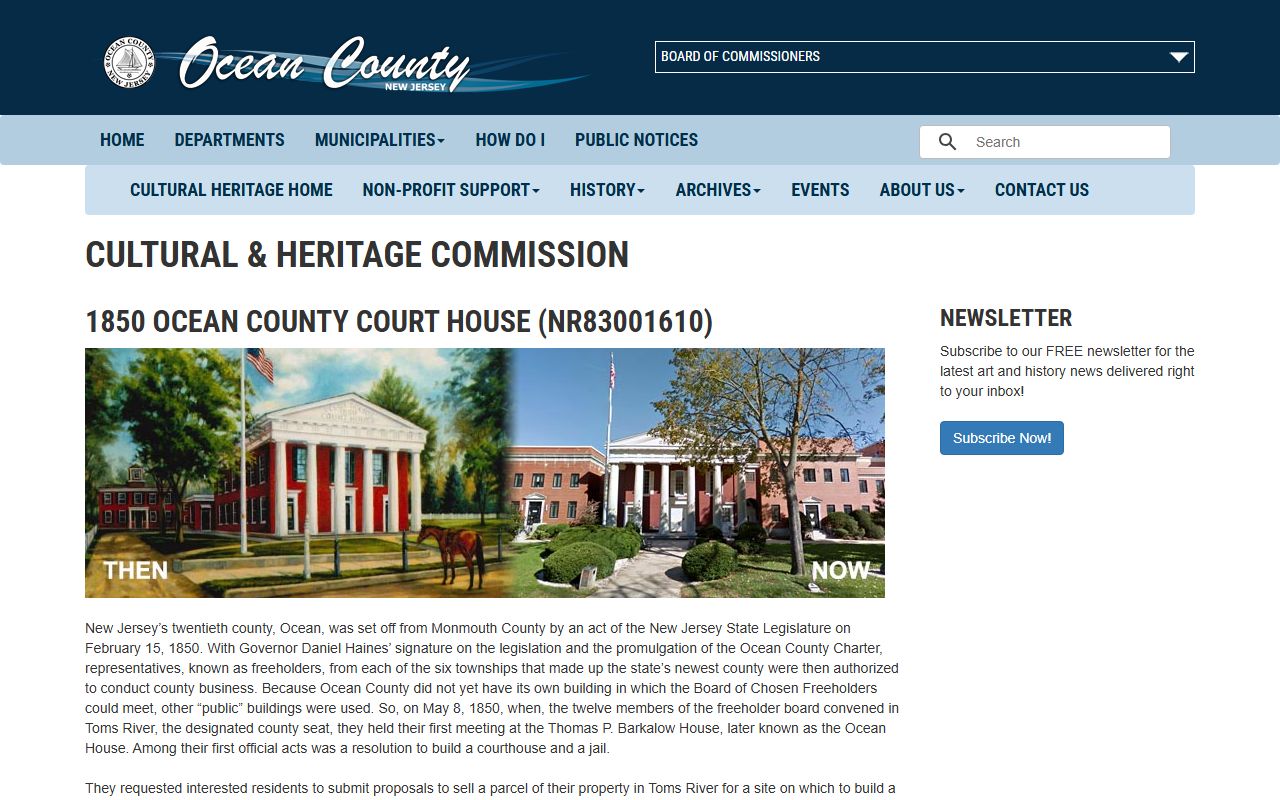
The county's Cultural and Heritage Commission identifies this as a National Register-listed Greek Revival brick structure built in 1850 and 1851, with six Doric columns and a pedimented portico. The courthouse was built shortly after Ocean County separated from Monmouth County on February 15, 1850, and it remains the legal anchor of Toms River's downtown. The Justice Complex grew around it as the county's population and caseload expanded over the following decades.
Ocean County Superior Court (Main)
118 Washington Street
Toms River, NJ 08753
732-504-0700
Justice Complex / Court Administration
120 Hooper Avenue
Toms River, NJ 08754
732-504-0700 ext. 64330
Trial Court Administrator: Jill Vito
Ocean County Surrogate's Court
118 Washington Street, 2nd Floor, Room 216
Toms River, NJ 08753
732-929-2011
The screenshot below comes from the Census Bureau's QuickFacts page for Ocean County and provides population context for the county that Vicinage 14 serves.
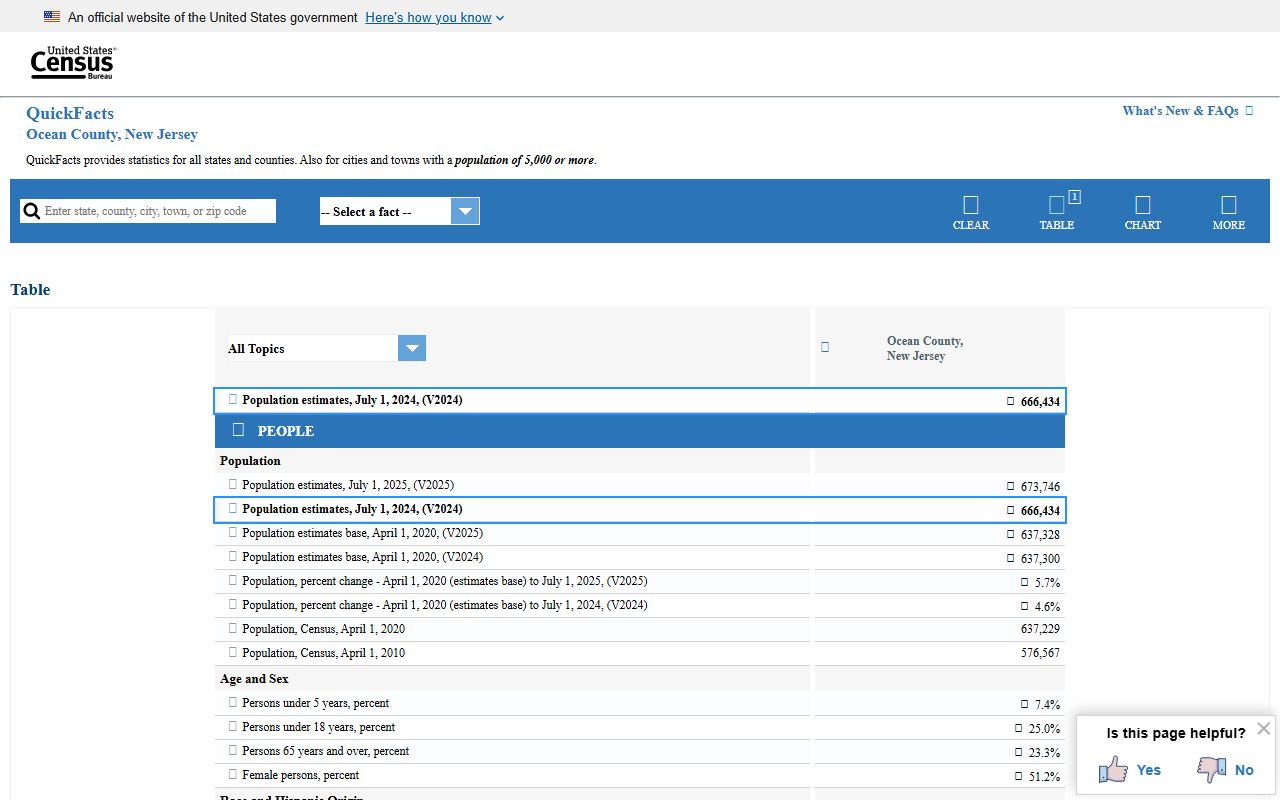
The county's 2025 population estimate is 673,746, with the 2020 census counting 637,229 residents across roughly 628 square miles of land. A county of that size generates substantial Superior Court caseloads each year across all divisions, which is why the vicinage runs separate division phone lines and a full staff of administrators.
For mailed record requests, follow the NJ Courts records request workflow described on the NJ Courts copies of court records page. For in-person help or navigation assistance, contact the Ombudsman at 732-504-0700 ext. 64480. The Ombudsman also handles accommodation requests for court access and interpreter services.