
The Ocean County Surrogate's Court
The Surrogate's Court is an elected constitutional office in New Jersey. Each county elects a Surrogate who carries the probate functions once held by the colonial governor. Ocean County Surrogate Jeffrey W. Moran leads the office. The Surrogate admits wills to probate, grants letters testamentary or letters of administration, oversees guardianship filings, enters adoption judgments, and handles estate accountings and caveats. It is not a court of litigation. When a matter is uncontested and a valid will exists, or when no will is present but the estate qualifies, the Surrogate can act quickly. Contested cases leave the Surrogate's hands and go before a judge.
The Ocean County Surrogate homepage gives a full description of the office and its functions. The screenshot below shows that page, which covers the Surrogate's role in Ocean County probate and estate administration.
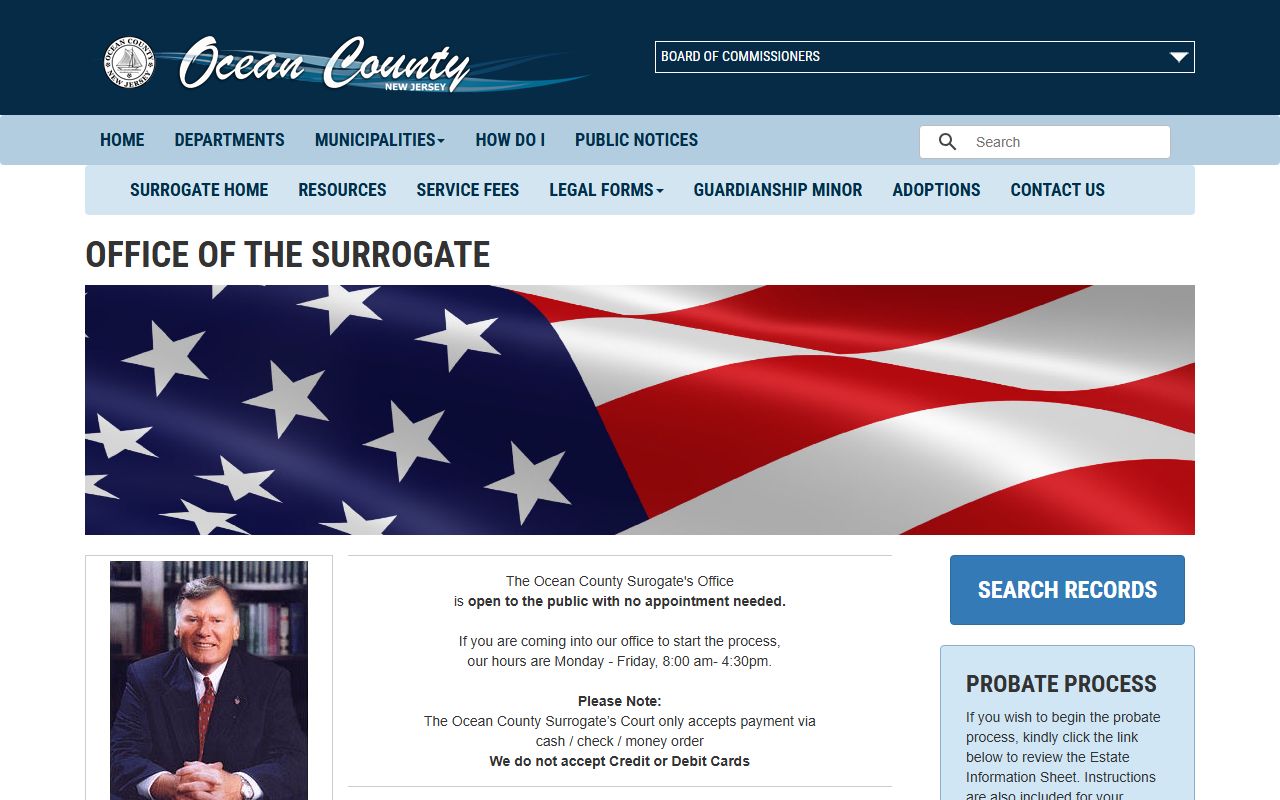
The homepage also links to fee schedules, forms, and information sheets that are useful before your first visit to the office.
The Surrogate's Court shares the courthouse campus with the Ocean County Superior Court, County Clerk, and other offices. Court-security screening applies at each secure building in the Justice Complex. Bring a valid photo ID, and do not bring recording equipment unless you have been authorized.
What Ocean County Probate Covers
Probate is the legal process that transfers a decedent's property to heirs and pays their debts. Ocean County Surrogate probate covers several distinct proceedings. Each one begins at the Surrogate's office and has its own required documents and fees.
The main proceedings the Ocean County Surrogate handles are:
- Probate of a will - the court confirms the will is valid and authorizes the executor to act. The decedent must have listed Ocean County as their place of residence on the death certificate.
- Letters of administration - when someone dies without a will (intestate), the Surrogate appoints an administrator and issues letters of general administration.
- Guardianship letters - issued for minors and, in qualifying cases, for incapacitated adults. Adult guardianship proceedings that require Superior Court oversight go to the Chancery Division.
- Caveats - a formal notice filed with the Surrogate that halts informal probate action until the matter is resolved or referred to the Superior Court.
- Accountings - formal estate accountings filed with the Surrogate's office to document how estate assets were managed and distributed.
- Adoptions - the Surrogate enters adoption judgments and seals the related records under state law.
Estate searches are also available. If you need to know whether a will was filed for a deceased Ocean County resident, you can request a search through the Surrogate's office for a fee of $10 per estate. The Surrogate staff can confirm whether letters have been issued and provide short certificates to authorized parties.
Ocean County Probate vs the Superior Court Chancery Part
Most estate work in Ocean County goes through the Surrogate. But some matters must go to the Superior Court, Chancery Division, Probate Part. The line between the two depends on whether the proceeding is contested or requires judicial oversight.
The Surrogate can act when the will is valid on its face, no one has filed a caveat, and the estate does not require court direction. Once a party contests a will, disputes an accounting, or challenges the appointment of an administrator, the Surrogate must refer the matter to the Chancery Division, Probate Part, for a judge to decide. Adult guardianship cases that go beyond the Surrogate's limited authority also proceed through the Superior Court. The Surrogate's office contact for Superior Court adult guardianship matters is Amanda Jarin at 732-831-3741. For estate litigation at the Superior Court level, Helen Oaks handles that track at 732-288-7840.
The Ocean County Superior Court page covers the broader Chancery Division and how contested matters move through the court. For records requests tied to a Superior Court probate order, contact the Superior Court Clerk.
Note: A caveat filed with the Surrogate costs $25 and puts a hold on informal probate action until the caveat is resolved or withdrawn, also at a cost of $25.
How to Probate a Will in Ocean County
The process follows a clear sequence. Before you go to the Surrogate's office, gather the death certificate and the original will. The death certificate is a required document, and it must show that the decedent was a resident of Ocean County at the time of death. Without that, the Ocean County Surrogate may not have jurisdiction to act.
- Confirm jurisdiction. Check that the death certificate lists Ocean County as the decedent's place of residence. If not, probate may belong in a different county.
- Gather the will and death certificate. Bring the original will and the certified death certificate to the Surrogate's office at 118 Washington Street, 2nd Floor, Room 216, Toms River.
- Complete the estate information sheet. This form identifies the estate, lists the heirs and legatees, and records how many short certificates (surrogate certificates) the executor will need to conduct estate business.
- Pay the probate fee. The base fee for probating a will of two pages or fewer is $100, with $5 for each additional page. Fees must be paid by cash, check, or money order. No credit or debit cards are accepted.
- Executor qualifies. The executor takes an oath and receives letters testamentary and the requested number of short certificates. Short certificates authorize the executor to act with banks, brokers, agencies, and other parties.
- If no will exists, apply for general administration. The Surrogate grants letters of administration for estates where no will was left. The fee for general administration is $125.
- Handle the estate. The executor or administrator gives required notice, inventories assets, pays creditors, files accountings as required, and distributes the estate. Contested steps go to the Superior Court, Chancery Division.
- Close the estate. File any required refunding bonds or releases, and obtain a discharge when all obligations are met. The Surrogate's miscellaneous forms page at frmMiscForms.aspx has the Application for Voluntary Discharge of Executor or Administrator C.T.A.
The Ocean County Surrogate information sheets page has printable guides covering probate, administration, guardianship, trusts, and accountings. The screenshot below shows that resource page.
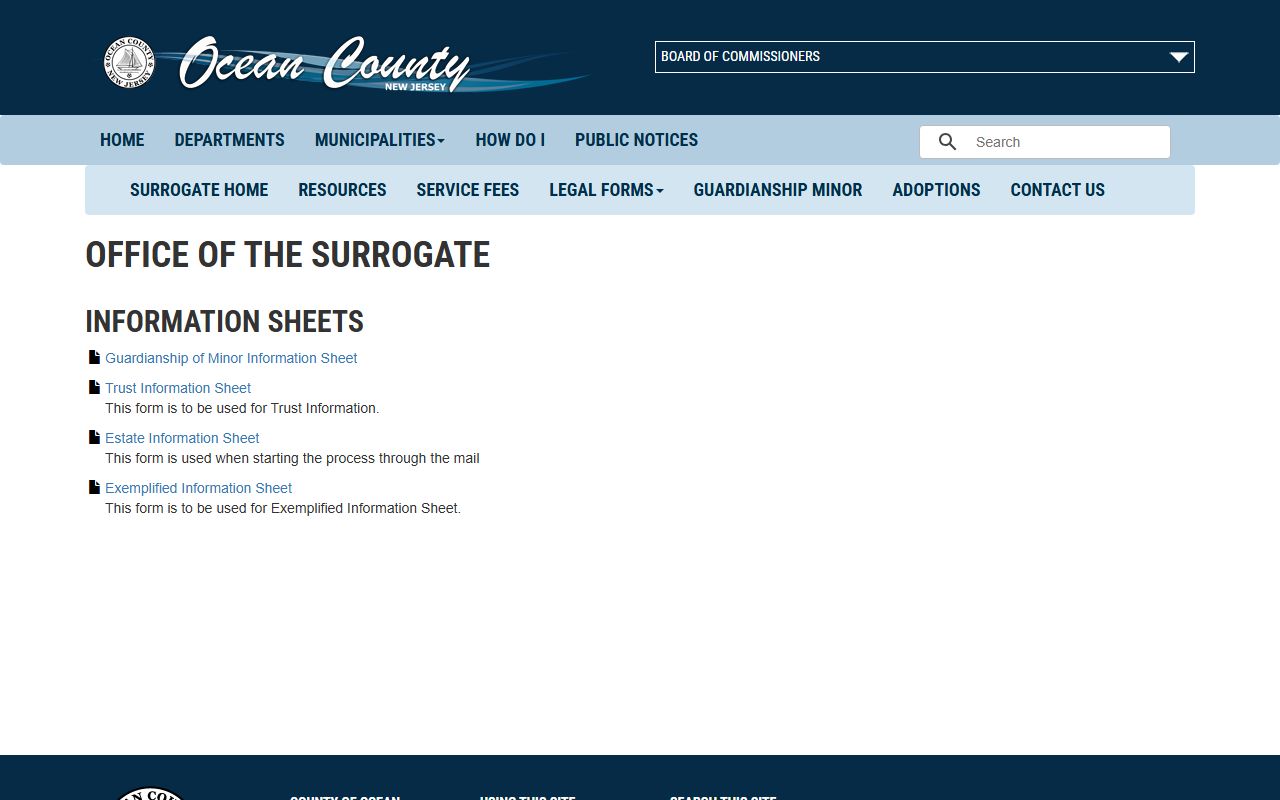
Each information sheet walks through what documents the Surrogate's office needs and what to expect at each step.
Ocean County Surrogate's Court Offices and Contacts
The Surrogate's office has two locations. The main office handles all filings. The southern service center in Manahawkin serves residents in the lower part of Ocean County by appointment every Friday. Staff contacts differ by function, so reach out to the right person to avoid delays.
Main Office - Toms River
118 Washington Street, 2nd Floor, Room 216
Toms River, NJ 08753
Mailing: P.O. Box 2191, Toms River, NJ 08754
732-929-2011
Southern Service Center - Manahawkin
179 South Main Street
Manahawkin, NJ 08050
Hours: Every Friday by appointment only
732-929-2011
The Surrogate contact page lists each staff member and their direct extension. The screenshot below shows that page with the full staff directory.
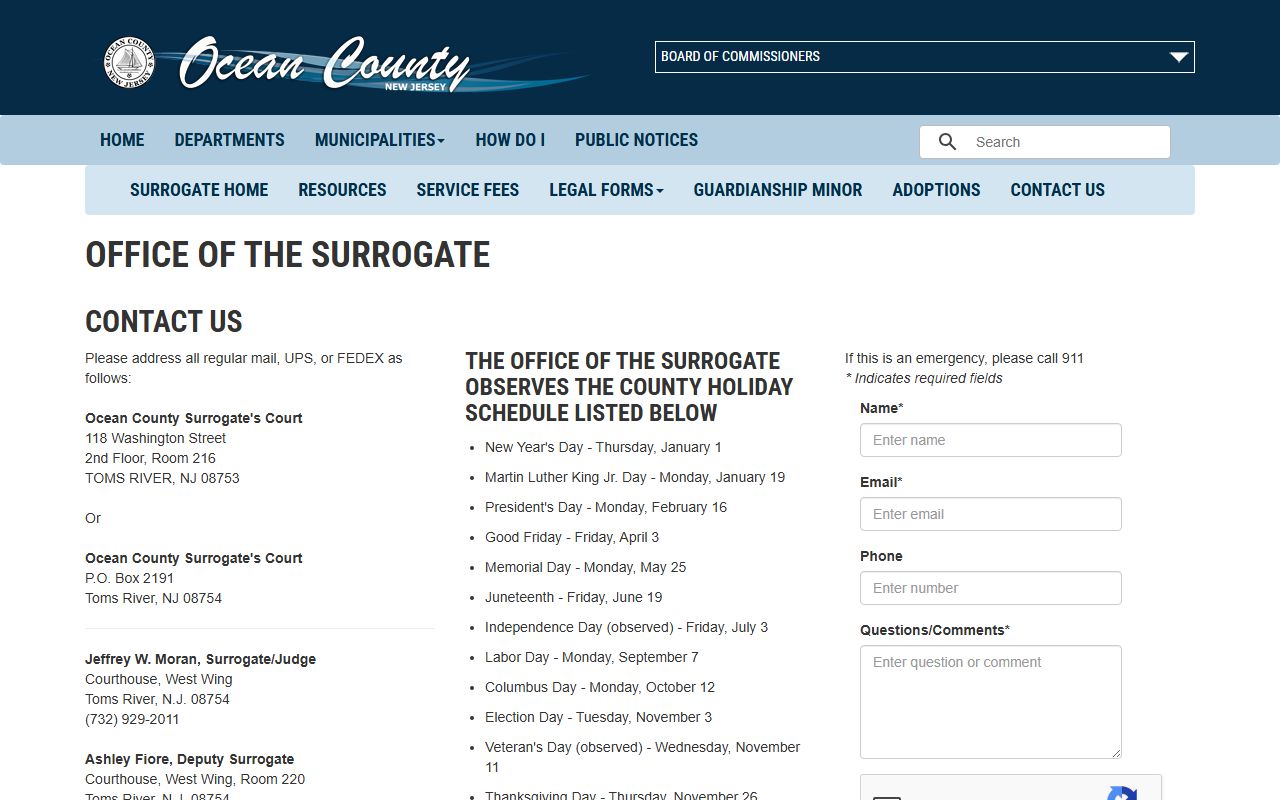
For specific needs, the key staff contacts are listed below. Reaching out directly cuts down on wait time significantly.
| Role | Staff Member | Phone |
|---|---|---|
| Chief Probate Clerk | Bonnie Huyler | 732-929-2011 ext. 3100 |
| Senior Probate Clerk | Elleia Giannotte | 732-929-2011 ext. 4379 |
| Probate Clerk | Montana Sudol | 732-929-2011 ext. 3443 |
| Probate Clerk | Valerie Szablewski | 732-929-2011 ext. 3350 |
| Adoptions & Minors Accounts | Gabrielle Spano | 732-506-5126 |
| Accountings | Elaina Puglisi | 732-506-5016 |
| Superior Court Adult Guardianships | Amanda Jarin | 732-831-3741 |
| Superior Court Estate Litigation | Helen Oaks | 732-288-7840 |
The Surrogate's office accepts written questions through the contact form on its website. The form requires your name, email, and a description of your question. Phone calls and in-person visits are also welcome during regular business hours.
Ocean County Probate Fees
All Surrogate fees are set by New Jersey statute and apply uniformly at the Ocean County office. Payment must be by cash, personal check, business check, or money order. The office does not accept credit or debit cards. Returned checks carry a $20 processing fee plus any bank fee assessed. The full schedule is published on the Ocean County Surrogate fee page.
| Service | Fee |
|---|---|
| Probate of will, not more than 2 pages | $100 |
| Each additional page of the will | $5 |
| Probate of will without letters (2 pages) | $50 + $5/additional page |
| Probate of codicil, not more than 1 page | $25 |
| Additional witness for codicil | $5 |
| Executor qualification / proof of extra witness | $25 |
| Commission | $35 |
| Copy of will (per page) | $3 |
| Certified extra copy of will (per page) | $5 |
| Certificate | $5 each |
| Certified copy of will with proofs (up to 2 pages) | $50 |
| Exemplifying will for use in another state (up to 2 pages) | $75 |
| General administration (intestate estate) | $125 |
| Administration Ad Prosequendum | $50 |
| Certified copy of administration | $50 |
| Guardianship letters / acceptance / power of attorney | $50 |
| Caveat filing or withdrawing | $25 |
| Search fee per estate | $10 |
| Short certificates | $5 each |
| Returned check processing fee | $20 plus bank fee |
The screenshot below shows the official fee schedule as published on the Ocean County Surrogate website.
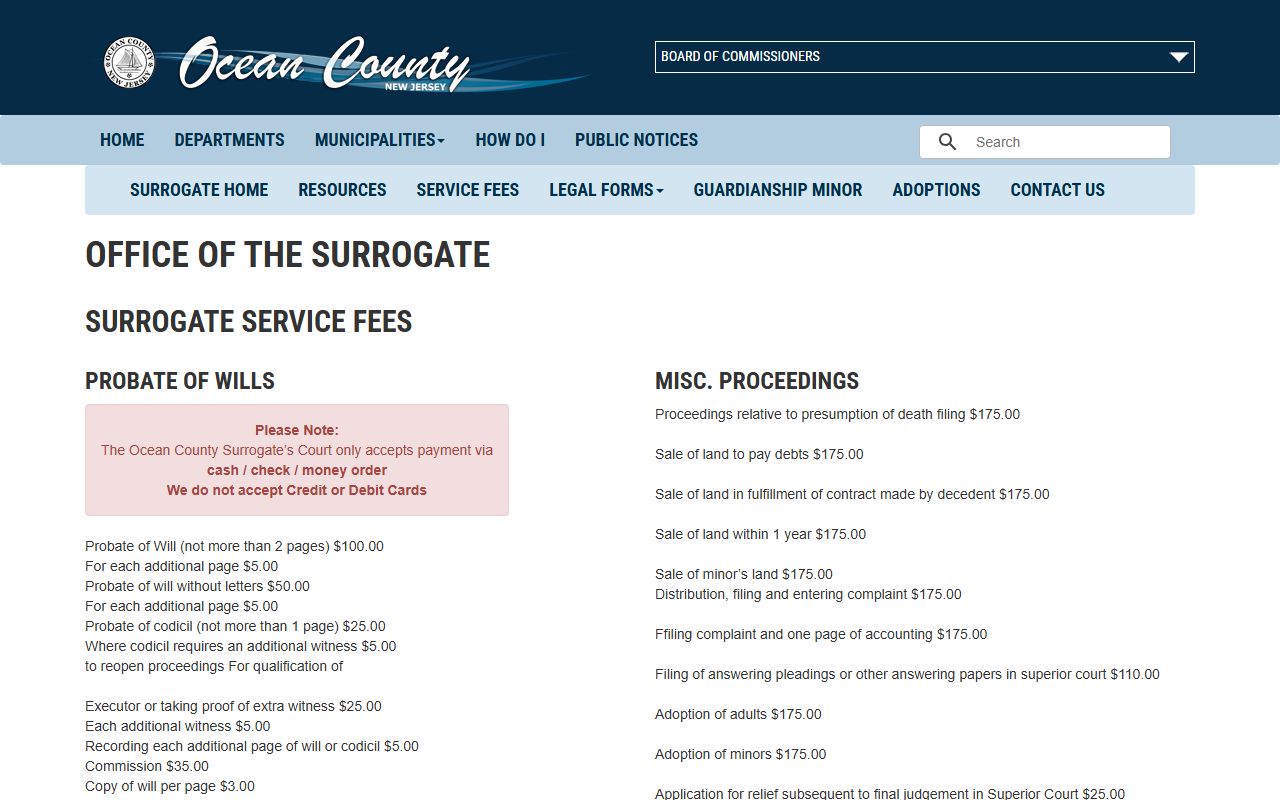
Short certificates are the documents executors and administrators use to conduct estate business. Order enough at the time of probate to avoid return visits and additional fees.
Note: Fees for Superior Court copies of contested probate orders follow NJ Courts copy rates, not Surrogate rates. A certified copy from the court costs $15; a plain copy costs $0.05 per letter-size page.
Estate, Guardianship, and Accounting Forms
The Ocean County Surrogate maintains two form libraries. The miscellaneous forms page covers estate administration, trustee functions, discharge applications, and related filings. The Superior Court forms page covers guardianship order-to-show-cause materials and other Chancery-level documents that the Surrogate coordinates but the court decides.
The miscellaneous forms page includes the following key documents. The screenshot below shows the current form list.
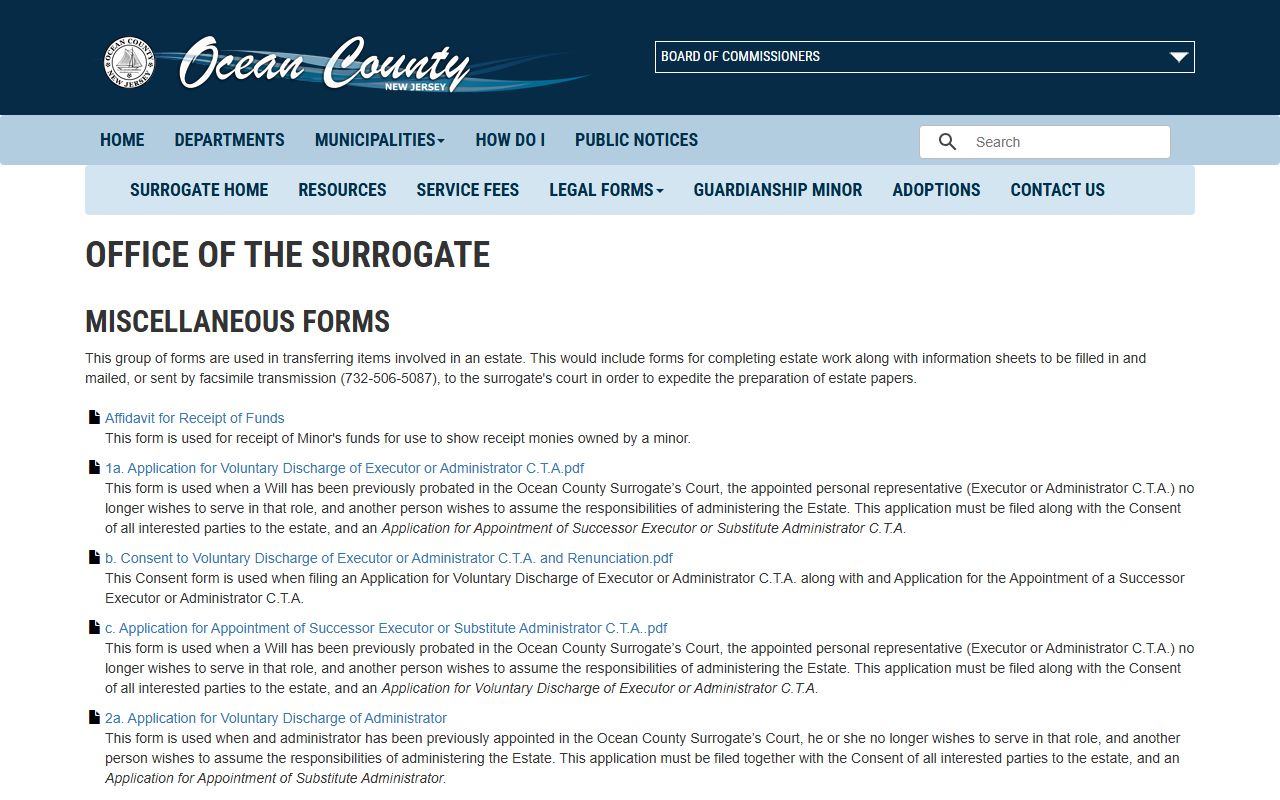
Forms available on that page include the Affidavit for Receipt of Funds, Application for Voluntary Discharge of Executor or Administrator C.T.A., Estate Information Sheet, Trust Information Sheet, Guardianship of Minor Information Sheet, Exemplified Information Sheet, and Guardianship Well Being Report. The Well Being Report is used for ongoing guardianship filings to report on the condition and care of the ward.
For matters that move to the Superior Court, the Surrogate also maintains Superior Court forms. The screenshot below shows the Superior Court forms page, which covers the How to File a Probate Order to Show Cause in Chancery Division guide, Temporary Guardianship Initial Order, and Consent and Waiver Form for guardianship matters.
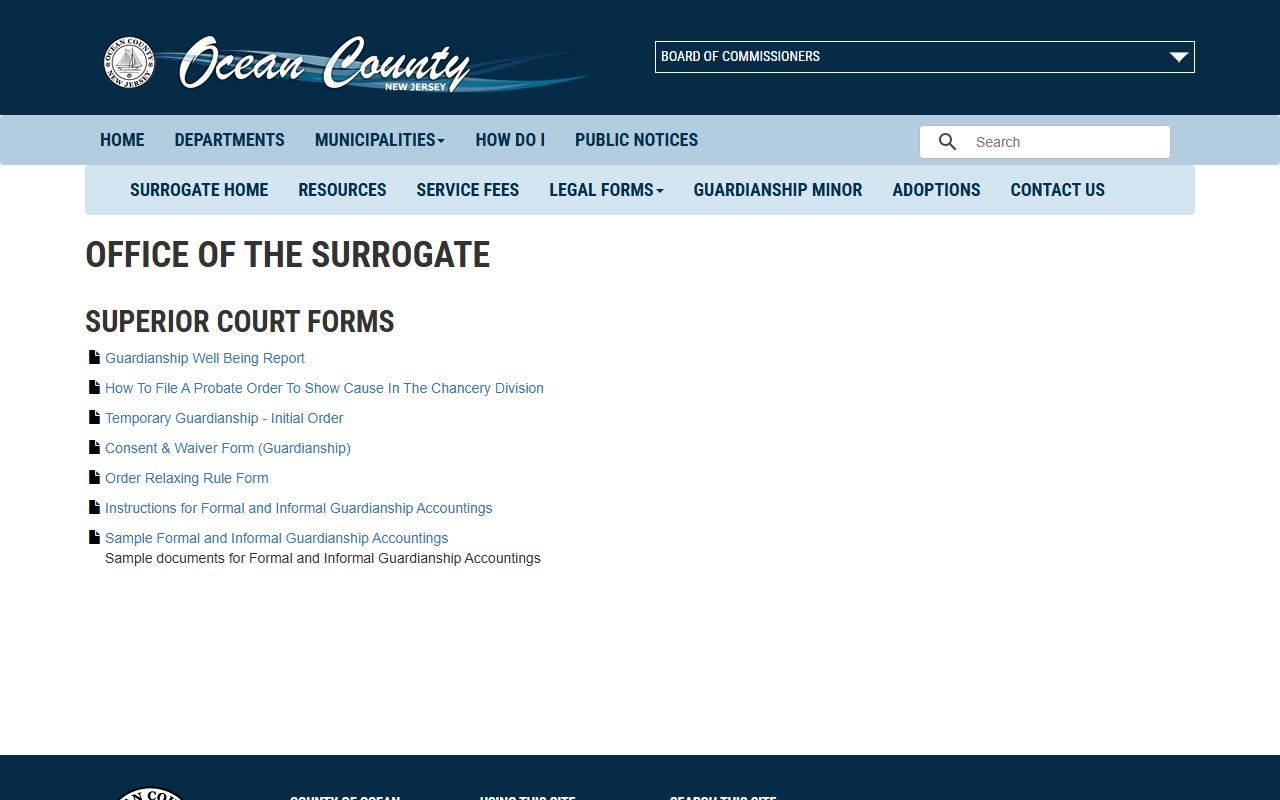
Use the Surrogate forms for routine estate work and the Superior Court forms when a judge must issue an order. Instructions for filing a Probate Order to Show Cause are included on the Superior Court forms page so that self-represented parties have a roadmap for the process.
Probate Terms Defined
Probate law uses specific terms that matter when you deal with the Surrogate's office. Knowing what each term means before you file avoids confusion and helps you bring the right documents. The definitions below cover the terms most likely to come up in Ocean County estate proceedings.
- Testator
- The person who made the will. When the testator dies, the will is submitted to the Surrogate for probate. The testator's death certificate must show Ocean County as the place of residence.
- Executor
- The person or institution named in the will to settle the estate. After the Surrogate admits the will to probate and the executor qualifies, the Surrogate issues letters testamentary authorizing the executor to act on behalf of the estate.
- Letters Testamentary
- The official certificate the Surrogate issues to the executor of a will. Banks, brokers, and government agencies require this document before dealing with the executor on estate matters.
- Intestate / Administrator
- Intestate means a person died without a valid will. In that case, the Surrogate does not probate a will but instead grants letters of general administration to a qualified person, called the administrator, who settles the estate under New Jersey law.
- Guardianship
- A legal arrangement where one person or entity is appointed by the court to care for another person who cannot manage their own affairs. The Ocean County Surrogate can issue guardianship letters in certain cases. Court-supervised adult guardianships go through the Superior Court, Chancery Division.
- Conservatorship
- A court-supervised arrangement for managing the property or finances of an incapacitated person. Related to guardianship but focused on assets rather than personal care decisions.
- Caveat
- A written notice filed with the Surrogate to prevent informal probate from proceeding. A caveat costs $25 to file and puts the estate on hold until the issue is resolved or the caveat is withdrawn. It is often the first step when a will's validity is in dispute.
These terms appear throughout the forms and information sheets on the Surrogate's website. If a form uses a term not listed here, the Surrogate's staff can explain what it means for your specific filing.
Restricted Probate and Guardianship Records
Not all Ocean County Surrogate records are open to the public. New Jersey Court Rule 1:38 and related statutes restrict several categories of probate and guardianship files.
Adoption records are the clearest restriction. Under N.J.S.A. 9:3-51 and 9:3-52, adoption judgments and related proceeding records are sealed. The Surrogate enters adoption judgments and places adoption files under seal. Those files can be opened only by order of a Superior Court judge in the Chancery Division, Family Part. Routine records requests will not produce adoption materials.
Certain guardianship records also carry restrictions. Rule 1:38 materials identify guardianship files as excluded from public access in many circumstances. Access may require a showing of special interest or a qualifying family relationship, depending on the nature of the proceeding. The Superior Court Adult Guardianships contact, Amanda Jarin at 732-831-3741, can tell you what is accessible in a specific matter.
Mental health and civil commitment records connected to probate or guardianship proceedings are also restricted under mental-health statutes and Rule 1:38. If a guardianship or estate matter involves protected health or psychiatric information, those parts of the file will not be released through a general records request.
For general court records questions about what is public and what is sealed under Rule 1:38, the Superior Court Clerk and the NJ Courts records request process are the right starting points. The County Clerk handles land records and OPRA requests for non-judicial county records, which follow different rules from court files.
Note: The judicial branch is not covered by OPRA. Court records, including Surrogate files, follow New Jersey Court Rule 1:38 and NJ Courts procedures, not the Open Public Records Act.