
How to Find Ocean County Marriage and Divorce Records
Two systems cover these records, and they are not linked. Marriage licenses in New Jersey are issued at the local level. Each applicant goes to the municipal registrar in the town where one of them lives. After the ceremony, the officiant returns the completed license to that registrar, and the record is eventually forwarded to the New Jersey Department of Health. That means the State of New Jersey, not the Ocean County Superior Court or the Ocean County Clerk, is the keeper of a typical marriage record.
Divorce is a court matter. New Jersey Courts call it dissolution, not divorce, though both words refer to the same legal process. Dissolution cases are filed in the Superior Court, Family Part, in the county where the petitioning party meets the residency requirement. For Ocean County cases, filing and hearings happen at the Ocean County courthouse complex in Toms River. Once the case closes, the file moves to the Superior Court Clerk's Office warehouse for storage. Researchers and parties who need a certified copy of the final judgment submit a request to that office.
Neither marriage records nor divorce records can be searched through a free public online portal. Vital records are not public records under New Jersey law. Divorce documents carry their own access restriction: the court releases them only to a party to the case or an attorney of record. Both systems require knowing which office holds the record and following the correct request process.
Ocean County Marriage Licenses Through Local Registrars
Marriage licenses in Ocean County are not issued by the county courthouse. They come from the local registrar in the New Jersey municipality where either applicant resides. If neither applicant is a New Jersey resident, the license is obtained in the municipality where the ceremony will take place. Ocean County has many municipalities, including Toms River, Lakewood, Brick, and Jackson, each with its own registrar's office.
The official application form is REG-D30, published by the New Jersey Department of Health. The form covers both marriage and civil union licenses. Applicants must complete this form and bring supporting documents to the local registrar. The registrar reviews the application, issues the license after any required waiting period, and retains a copy. After the ceremony, the signed and officiant-completed license goes back to the registrar, who sends a certified copy to the state.
Copies of a marriage record issued on or after 1951 must be requested from the New Jersey Department of Health Vital Statistics office. For marriages through 1950, the New Jersey State Archives holds the records. Local registrars can also issue certified copies of events that occurred in their municipality, and their fees may differ from the state's fees. There is no free public online search. Vital records are classified as non-public in New Jersey.
Note: Customers can order vital records through VitalChek, by phone, or by walking into the DOH vital records office at 140 East Front Street, Trenton.
NJ Vital Statistics and Ocean County Marriage Records
The New Jersey Department of Health is the state agency that maintains the official marriage record index. Its Vital Statistics unit holds records from 1951 forward, and the New Jersey State Archives covers the period through 1950. These are the authoritative sources for certified marriage records connected to Ocean County events. The DOH does not operate a free public search portal for marriage records. Access is restricted by state law, and the agency does not confirm whether a marriage occurred to the general public.
The NJ Vital Statistics page at the Department of Health is the starting point for ordering a certified copy of a marriage record. From that page, users can follow the link to order through VitalChek, get the current fee schedule, and find information about eligibility. The screenshot below was captured from that source.
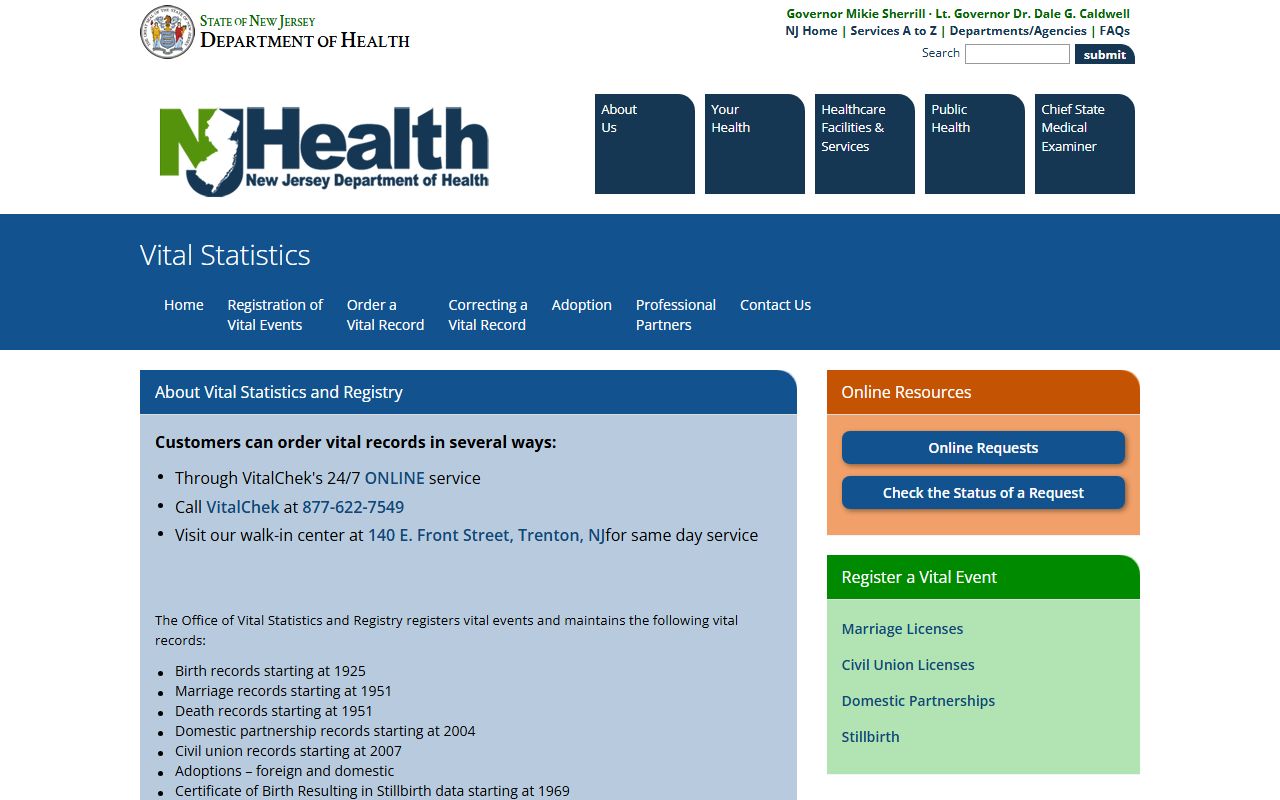
That page covers all vital record types the DOH maintains, including marriage, birth, death, civil union, and domestic partnership records. Fees and processing times for certified copies are listed there and may be updated by the agency from time to time.
The NJ Vital Statistics FAQ answers common questions about who can order records, what documents are accepted as proof of identity, and how to handle requests for events that occurred in other states. Local registrar guidance is also covered in the FAQ, shown in the screenshot below.
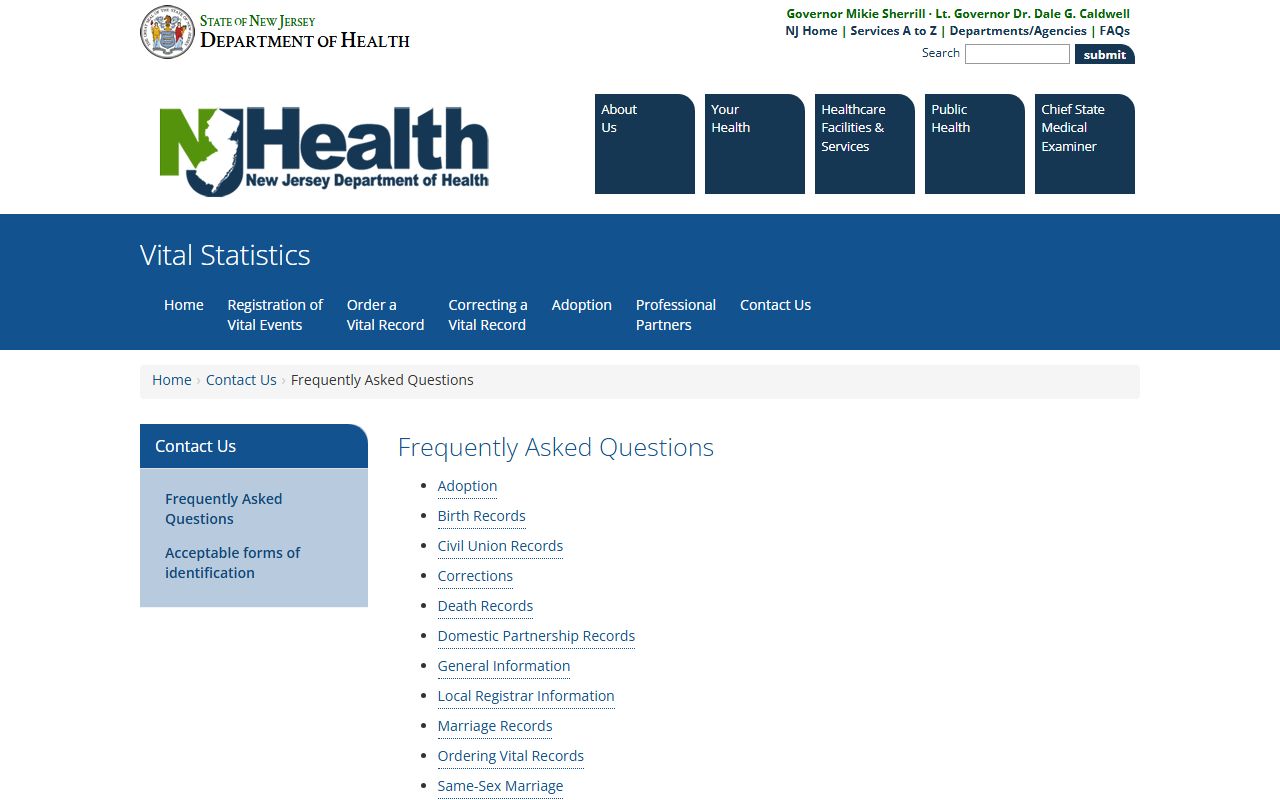
The FAQ explains that a local registrar copy is requested from the municipality where the event occurred. Fees vary by municipality, so check with the specific town registrar for current pricing before making the trip.
How to Apply for a Marriage License in Ocean County
Applying for a marriage license starts at the registrar's office in one of the applicants' home municipality. Both parties generally need to appear together. The steps below follow NJ Department of Health guidance and the REG-D30 form requirements.
- Find the correct registrar. Go to the municipal clerk or registrar's office in the New Jersey town where either applicant lives. If neither lives in New Jersey, use the municipality where the ceremony will take place.
- Get form REG-D30. The official NJ marriage and civil union license application is available from the DOH. Many registrars also keep printed copies on hand at the counter.
- Complete all required sections. Fill in identifying information, residence, birth data, parent information, prior marriage or civil union status, and intended ceremony details. Both applicants complete their own sections. Witnesses complete the witness section.
- Submit to the registrar with supporting documents. Bring valid government-issued photo ID and any documents the registrar requires, such as proof of a prior divorce decree or name change if applicable to your situation.
- Pay the license fee. Fees are set by the municipality and can vary from town to town. Ask the registrar for the current amount before your visit so you bring the right form of payment.
- Receive the license and plan the ceremony. After review and any required waiting period, the registrar issues the license. It is valid for a fixed time after issuance, so schedule the ceremony within that window.
- Return the completed license after the ceremony. The officiant signs the license at the ceremony. That signed document goes back to the municipal registrar, who records the marriage and forwards the record to the state for inclusion in the DOH vital records index.
Marriage License Application Fields (Form REG-D30)
The NJ marriage and civil union license application, form REG-D30, covers both applicants across several sections. The table below lists the main field categories from the form as documented in official DOH sources. Exact field labels may differ slightly from what you see on the printed version at the registrar's office.
| Section | Fields Covered |
|---|---|
| Applicant Identifying Info | Full legal name (first, middle, last), name after marriage or civil union |
| Residence | Street address, city or town, state, zip code, county, country of residence |
| Birth Information | Date of birth, place of birth (city, state, country), age at time of application |
| Parent Information | Father's full name, mother's full name including birth surname |
| Prior Marriage or Civil Union Status | Number of prior marriages or civil unions, how the last one ended (death, divorce, dissolution, annulment), date it ended |
| Intended Ceremony Information | Date of ceremony, municipality where ceremony will take place, type of ceremony (religious or civil) |
| Witness Information | Witness name, witness address |
| Registrar and Officiant Sections | Registrar signature, date issued, license number; officiant name, title, signature, and date of ceremony |
Both applicants complete their own set of identifying, residence, birth, and parent fields. The form collects matching data from each party side by side, which is why it works for both marriage and civil union licenses. A completed REG-D30 becomes a government document. Keep a copy for your own records after the ceremony in case you need to reference the license number or filing date later.
Divorce in the Ocean County Superior Court Family Part
New Jersey refers to divorce as dissolution. The Superior Court, Family Part handles all dissolution cases at the county level. For Ocean County, that means the case is filed, heard, and decided at the Superior Court in Toms River, part of Vicinage 14. The Family Part also handles custody, child support, parenting time, domestic violence, and adoptions, so dissolution cases share the division with a wide range of family law matters.
A dissolution case opens with a complaint filed by one spouse, called the plaintiff or petitioner in New Jersey court language. The complaint states the legal grounds for the divorce and the relief being sought, which can include equitable distribution of marital property, alimony, child custody, child support, and parenting time. Equitable distribution is the court process of dividing marital assets and debts between the spouses; equitable does not mean equal, and the court weighs many factors in deciding how to split things. The other spouse, called the defendant or respondent, has an opportunity to answer the complaint and present their own position.
From there the case follows the Family Part's case-management schedule through discovery, motions, settlement efforts, and, if needed, trial. Most dissolution cases settle before reaching trial. A mediated settlement or negotiated agreement is entered as the final judgment of divorce, which the court signs and enters into the record.
Ocean County dissolution dockets use the prefix FM or, in older cases, M. The docket number format used in NJ Courts guidance looks like FM-15-07500-24, where the county code for Ocean County is 15 and the last two digits reflect the filing year. That structure helps a researcher or clerk confirm the correct county when searching or requesting records. Docket numbers are assigned when the complaint is filed and stay with the case through its full history, including appeals. The Ocean County Superior Court page has more on how the Family Part fits into the broader court structure.
Ocean County Divorce Archive Year and Requesting Records
After a dissolution case closes, the file does not remain at the Ocean County courthouse indefinitely. New Jersey transfers closed case files to the Superior Court Clerk's Office warehouse in Trenton after a set period. The NJ Courts Dissolution Files Inventory identifies Ocean County as county number 15, with a case inventory year of 2011. That means dissolution files up through at least that year are available through the Superior Court Clerk's Office rather than at the local Ocean County courthouse.
To locate a closed dissolution file when you do not know the docket number, contact the Superior Court Clerk's Office Customer Service at 609-421-6100. The staff can conduct a search if you provide the county name (Ocean County), an approximate year of the case, and the full names of both parties. This is the official research path when the docket number is missing or unknown. Having the approximate year narrows the search considerably, so gather any documents that might show a date before calling.
Once the file is located, the next step is to request the specific document needed. A Certificate of Divorce is the simpler option and costs $10. It confirms that a divorce occurred, identifies the county venue, the docket number, the parties by name, and the date of the final judgment. It does not include the full text of the judgment or other documents from the case file. For a complete certified copy of the final judgment of divorce, the fee is $25. That document carries the court's certification and the full judgment text, including any rulings on property, support, and custody.
The NJ Courts divorce self-help page, shown below, is the main resource for people who are filing for dissolution without an attorney. It covers required forms, the filing process, and links to official court guides on equitable distribution, custody, and support.
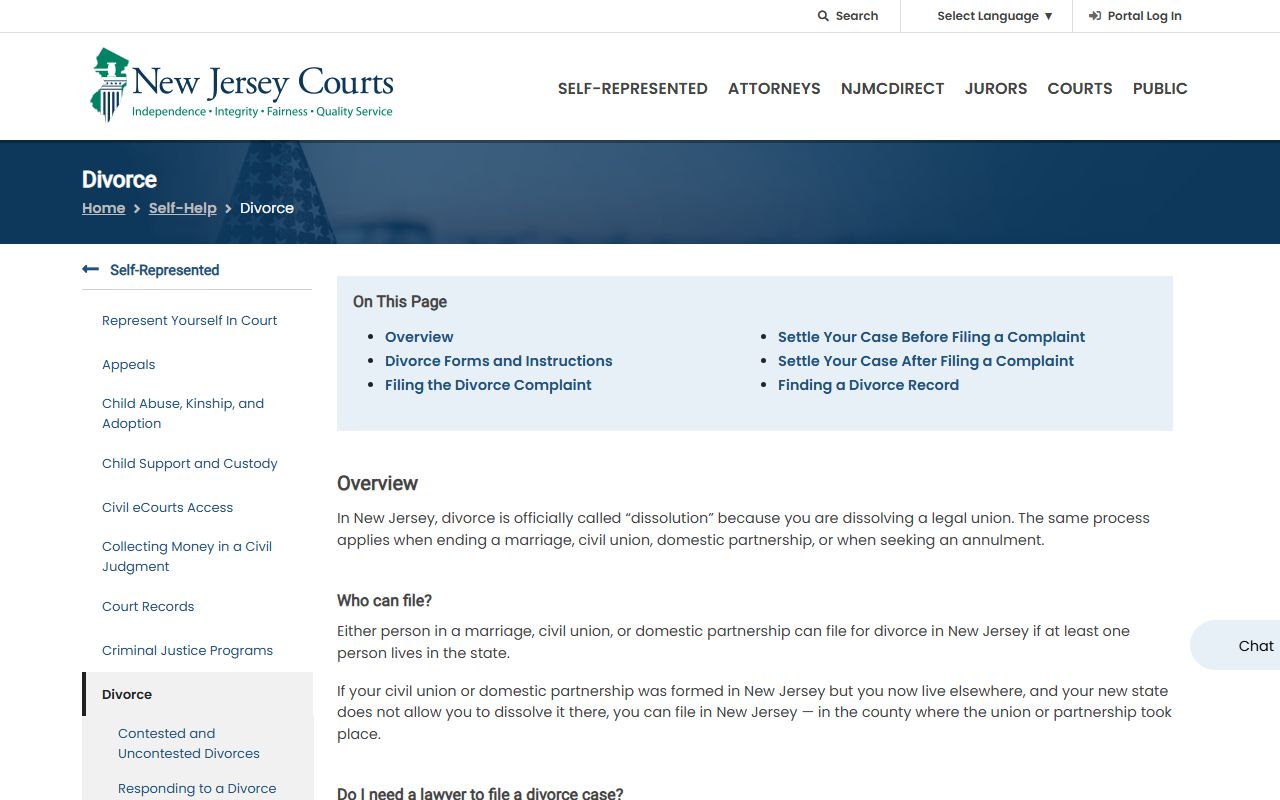
The NJ Courts divorce self-help page also links fee waiver information for people who cannot afford the filing fee, which is a separate process from the records request fees listed in the section below.
Ocean County Divorce Record Fees
The NJ Courts copy fee schedule applies to all court records, including dissolution files, requested through the Superior Court Clerk's Office or the county's Superior Court divisions. Pay by check or money order payable to Treasurer-State of New Jersey. Cash is accepted in person only. Attorney clients may use a Superior Court Attorney Collateral Account. Preprinted checks are required; personal checks with hand-written account information are not accepted by the court.
| Document or Item | Fee |
|---|---|
| Certificate of Divorce | $10 |
| Certified copy of final judgment of divorce | $25 |
| Certified copy (general court documents) | $15 |
| Seal of the Court | $10 |
| Exemplified copy (plus plain copy fees) | $50 |
| Triple exemplified copy | $60 |
| Plain copy, letter size | $0.05 per page |
| Plain copy, legal size | $0.07 per page |
| Certificate of statewide judgment lien | $10 |
An exemplified copy is a certified copy that carries the clerk's attestation, the court seal, and a judge's certificate confirming the clerk's signature is genuine. It is the highest-level authentication available from the court and is often needed when a New Jersey divorce must be formally recognized in another state or a foreign country. Triple exemplification adds a third authentication layer and is used in certain international legal proceedings where a single exemplified copy does not meet the receiving country's requirements.
These fees cover dissolution records only. The Surrogate's Court page lists its own fee schedule for wills, estates, and guardianship matters. The Surrogate handles probate, not divorce.
Divorce Document Restrictions in Ocean County
Ocean County divorce records are not public records in the same way civil court records are. NJ Courts states that divorce documents are released only to a party to the case or an attorney of record, unless a court order specifically directs the clerk to release them to someone else. This rule applies to both open and closed Ocean County dissolution files, regardless of how old the case is.
A party to the case is either spouse named in the dissolution action. An attorney of record is a licensed attorney who formally appeared in the case. Both must show valid government-issued state ID when requesting records in person. Mail requests require a copy of the ID along with the written request. If the ID name differs from the case name due to a prior name change or other reason, the clerk may need additional documentation before releasing the file.
Third-party access is more complicated. A person who is not a party and is not an attorney of record must obtain a court order from the Superior Court, Family Part, directing the clerk to release the specified documents. That requires filing a motion and showing good cause. The process takes time and money, so third parties should consult an attorney before pursuing it.
This restriction is separate from OPRA. The Open Public Records Act covers county and local government agency records. The Government Records Council has no jurisdiction over court case files. The judiciary operates under Court Rule 1:38 and the NJ Courts records request system. A person denied access to a dissolution file cannot appeal to the GRC; the remedy runs through the court itself. More detail on the boundary between OPRA and court records access is on the Ocean County public records page.
Important: Divorce documents are released only to a party to the case or an attorney of record. Any requesting party must show valid government-issued state ID. Third parties need a Superior Court order to access these files.
For records questions related to the Superior Court Clerk's Office, including how to complete and submit a records request form, that page covers the workflow and accepted payment methods. For county agency records outside the court system, including land records and property filings, the County Clerk page explains the Ocean County Clerk's separate records and OPRA process.
Key Terms for Ocean County Marriage and Divorce Records
New Jersey courts and vital records offices use specific legal terms that may be unfamiliar to someone requesting records for the first time. The definitions below cover the terms that come up most often in Ocean County dissolution and marriage license matters.
- Dissolution
- The legal term New Jersey courts use for divorce. A dissolution case ends a marriage or civil union by court judgment. Both words refer to the same legal outcome; official court documents and dockets use dissolution.
- FM docket prefix
- The docket prefix assigned to dissolution cases in the Superior Court Family Part. Older cases may carry the prefix M alone. Ocean County's code in the docket number is 15, so Ocean County dissolution cases have dockets that begin FM-15.
- Equitable distribution
- The court process of dividing marital assets and debts between spouses in a dissolution case. Equitable does not mean equal; the court weighs many factors, including the length of the marriage, each party's income and assets, and contributions to the household.
- Certificate of Divorce
- A short official document confirming that a divorce occurred in New Jersey. It lists the county venue, docket number, parties' names, and the date of the final judgment. It costs $10 and does not include the full text of the judgment or other case documents.
- Final Judgment of Divorce
- The court order that legally ends the marriage. It may address property division, alimony, custody, child support, and other matters resolved in the case. A certified copy costs $25 from the Superior Court Clerk's Office.
- Registrar
- The local municipal official who issues and records marriage and civil union licenses. Ocean County's many municipalities each have their own registrar. The registrar is the first point of contact for both obtaining a license and requesting a local certified copy of a marriage record.