
How to Search Ocean County Court Records
The New Jersey Judiciary runs a set of statewide case portals that cover every vicinage, including Ocean County, which is Vicinage 14. There is no separate county-built search tool for Superior Court cases. The portals you use depend on the case type. Civil and foreclosure matters use the Civil Case Jacket Public Access portal. Criminal matters use the criminal public access system. Municipal tickets and complaints use Municipal Court Case Search or NJMCDirect. If a case is closed or archived, the NJ Courts records request workflow through JEDS routes the request to the correct office, often the Superior Court Clerk's Office in Trenton.
Knowing the case type before you start is the single most useful step. Ocean County Superior Court hears Law Division civil and criminal cases, Chancery Division general equity, the Family Part, and the Probate Part. Municipal Courts handle traffic, parking, local ordinances, and disorderly persons matters. Each of these has its own portal, its own records request path, and its own access rules under Court Rule 1:38. Mixing them up causes delays.
- Decide whether the case is civil, criminal, family, or municipal. That choice tells you which portal to use.
- Collect the docket number if you have it. NJ docket numbers carry a type prefix and the county code 15 for Ocean inside the string.
- If you have no docket number, search by the party name and filter by county, case type, and approximate filing year.
- Open the case jacket to read the docket entries, case status, and any judgment information.
- For cases that are not online, complete the NJ Courts records request form, select the right processing location, and submit through JEDS. Records are sent to the email address on the form.
- Contact the relevant Superior Court division or the Superior Court Clerk's Office directly if the portal returns no results and you believe the case exists.
Note: Ocean County's NJ Courts county code is 15. That code appears inside most docket numbers for cases filed here, including the two-digit year component. A docket like FM-15-07500-11 is a Family dissolution case filed in Ocean County in 2011.
Ocean County Court Records Search Fields
The Civil Case Jacket Public Access portal uses a small set of fields to locate a case. The portal was protected during research, so the field inventory below comes from official NJ Courts public access guides and training materials. The criminal public access portal and the municipal portals share a similar structure. Knowing the field types before you open a portal helps you gather the right information in advance.
| Field Label | Type | Required | Notes / Format |
|---|---|---|---|
| Docket Number | Text | Method dependent | Prefixes: L (Law civil), LT (landlord-tenant), DC (Special Civil), SC (small claims), F (foreclosure), FM or M (dissolution/divorce). County code 15 for Ocean. |
| Party Name | Text | Method dependent | Used when the docket number is not known. Enter last name first where prompted. |
| Judgment Number | Text | Method dependent | For statewide judgment and lien searches via the Civil Judgment and Order Docket guide. |
| County / Court | Dropdown | Likely | Select Ocean County; code 15. Required to scope results to Vicinage 14. |
| Case Type / Docket Type | Dropdown | Likely | Civil, foreclosure, special civil, landlord-tenant, small claims, dissolution. Narrows results to the correct division. |
| Search / Reset | Button | Yes / Optional | Runs the query or clears fields. The older judgment system used SHIFT PF12 to clear per NJ Courts guides. |
For municipal matters, the search fields differ slightly. The municipal portals use a ticket number, complaint number, court ID, and prefix rather than a Superior Court docket number. Details on those searches appear in the municipal records section of the traffic court records page.
Types of Ocean County Court Records
Ocean County court records span several divisions, and each division produces a different category of case file. The records do not all live in the same system, and they do not all have the same access rules. The main categories are described below.
Civil records come from the Superior Court Law Division and Special Civil Part. The Law Division handles cases where plaintiffs seek more than $20,000, including automobile accidents, medical malpractice, and contract disputes. The Special Civil Part handles cases over $5,000 through $20,000, as well as landlord-tenant matters and small claims under $5,000. Civil case documents can include the complaint, the answer, motions, orders, judgments, and writs of execution. Most civil records are public under Rule 1:38 unless sealed by court order.
Criminal records from the Criminal Division cover indictable adult cases. Those include first appearances after indictment or complaint, pretrial motions, pleas, trials, sentences, and post-conviction motions. The documents in a criminal case can include a complaint-warrant or complaint-summons, an indictment issued by a grand jury, a plea form, judgment of conviction, sentencing order, and terms of probation. Presentence reports, victim information, and sealed warrants are not public.
Family records from the Family Part include divorce, custody, parenting time, child support, domestic violence, juvenile delinquency, adoption, and child welfare cases. NJ Courts calls divorce a dissolution case. Family records have limited public access. Divorce documents are released only to a party or attorney of record unless a court order directs otherwise. Adoption records are fully sealed.
- Probate records - wills, letters testamentary, estate administration, guardianships, and caveats. Handled by the Ocean County Surrogate and, for contested matters, the Chancery Division Probate Part. See the Surrogate's Court page.
- Municipal records - motor vehicle violations, parking tickets, local ordinances, and disorderly persons matters. Each municipal court in Ocean County keeps its own records. See the traffic court records page.
- Judgment liens and foreclosure records - handled through the Superior Court Clerk's Office for record requests. Older judgments before February 1984 were indexed by hand and are not in the online judgment system.
- Tax Court records - appeals of property tax assessments and state tax decisions. Ocean County's Tax Court functions are tied to the county Board of Taxation, located in the courthouse west wing.
Full case history and docket entries for civil and criminal matters are best explored through the court dockets page, which explains what a docket entry means and how to read event sequences.
What Ocean County Court Records Show
A New Jersey court record holds the case identity and a log of every filed document and court event. The fields below appear on most civil and criminal case dockets in Ocean County. Some fields are redacted to protect privacy. Social Security numbers, financial account numbers, victim addresses, minor identities, and confidential medical records are removed from public filings. The remaining fields tell a complete story of how a case moved through the system.
| Field | What It Shows |
|---|---|
| Docket Number | Unique case ID. Includes a type prefix, the county code 15 for Ocean, and a two-digit filing year. |
| County / Court / Division | Which division heard the case: Law Division, Chancery, Family Part, Special Civil, or Municipal Court. |
| Filing Date / Filing Year | When the case was opened. The year is also encoded in the docket number suffix. |
| Case Caption / Parties | Full names of plaintiff or petitioner and defendant or respondent, plus attorneys of record and the assigned judge. |
| Docket Type / Case Type | The type of case: civil, foreclosure, landlord-tenant, small claims, dissolution, criminal, or equity. |
| Case Status | Current stage: pending, active, closed, disposed, dismissed, sealed, expunged, archived, or transferred. |
| Docket Entries / Event Log | Chronological list of filings and court events: complaint filed, motions, orders, hearings scheduled, judgment entered, appeal filed, satisfaction filed. |
| Hearing Data | Courtroom number, event date and time, judge assigned, and event type for each scheduled appearance. |
| Financial Data | Filing fees, fines, court costs, restitution ordered, bail or bond information, judgment amount, and satisfaction of judgment if filed. |
| Disposition | Final outcome: guilty, not guilty, dismissed with prejudice, dismissed without prejudice, settled, default judgment, or sentence imposed. |
| Judgment / Order | The final enforceable decision: money owed, sentence, custody arrangement, injunction, or dismissal. |
| Copy Type Available | Plain copy, certified copy, seal, exemplified, triple exemplified, divorce certificate, certified final judgment of divorce. |
The NJ Courts copies of court records page explains these fields and outlines the records request workflow. A certified copy carries the court's attestation. An exemplified copy adds a judge's certificate and is used for out-of-state legal proceedings.
Public Access Framework for Ocean County Court Records
New Jersey uses two separate records laws that operate in parallel. Executive, county, and municipal government records fall under the Open Public Records Act, N.J.S.A. 47:1A-1 et seq. The Government Records Council administers OPRA and handles denial-of-access complaints. However, the GRC itself makes clear that the judicial branch is not a public agency under OPRA. That means Ocean County court case files, dockets, and filings are not OPRA records. They follow a completely different framework.
Court records are governed by New Jersey Court Rule 1:38, which defines what is open and what is excluded. NJ Courts states that civil, special civil, criminal, family, municipal, and Tax Court records are available for public inspection subject to the exceptions listed in Rule 1:38. Those exceptions are not small. They cover adoption records, juvenile delinquency files, domestic violence victim information, mental health and civil commitment records, grand jury materials, sealed warrants, expunged records, presentence reports, and unfiled discovery. If a record falls into one of those categories, it is simply not available without a court order or qualifying legal relationship to the case.
For county agency records, such as Sheriff's Office administrative records or County Clerk files, OPRA applies. The Ocean County government maintains an OPRA information page and accepts written requests by hand delivery, mail, or electronic transmission. Verbal requests do not qualify as OPRA requests. The standard response deadline for OPRA is seven business days for available records. The OPRA statute, N.J.S.A. 47:1A-1 et seq., is the controlling law for those agency requests.
Which law applies? Use OPRA for Ocean County Clerk, Sheriff, and county agency records. Use NJ Courts records request procedures and Rule 1:38 for Superior Court case files, Family Part records, and any court docket or filing. Using the wrong process adds delays.
The distinction matters for most common requests. Someone looking for a land deed, a tax lien filed with the County Clerk, or a Sheriff's civil-process record uses the OPRA path. Someone looking for a court case file, a judgment, a divorce decree, or a criminal docket uses the NJ Courts path. The public records page covers the OPRA process in more detail.
Records That Are Sealed or Confidential
Court Rule 1:38 carves out a significant set of records from public access in Ocean County. The categories below are restricted by statute, rule, or prior case law. In most cases you cannot obtain these records without a court order or qualifying legal standing.
- Juvenile delinquency records - restricted under N.J.S.A. 2A:4A-60. Access is limited to courts, probation officers, prosecutors, law enforcement, parents or guardians, and counsel. These are never treated as ordinary public criminal records.
- Adoption records - sealed under N.J.S.A. 9:3-51 and 9:3-52. NJ Courts states adoption records are not public in New Jersey and require a Superior Court order to open, issued by the Chancery Division, Family Part.
- Divorce documents - not public for all requestors. Divorce documents are released only to a party or attorney of record unless a court order directs the clerk to release them. A party must include valid state ID when requesting.
- Domestic violence records - victim names, addresses, and certain restraining-order records are protected.
- Mental health and civil commitment - excluded from public access under mental health statutes and Rule 1:38 references. N.J.S.A. 30:4-24.3 and related rules apply.
- Expunged records - removed from public record under N.J.S.A. 2C:52-1 et seq. Once expunged, a case does not appear in public searches and does not need to be reported for most jobs, housing, or school applications. Law enforcement keeps limited access for narrow legal purposes.
- Grand jury materials, presentence reports, and unfiled discovery - all excluded from public inspection under Rule 1:38 and related guidance.
New Jersey also performed automatic expungements for many marijuana and hashish cases after the Marijuana Decriminalization Law. Eligible offenses under N.J.S.A. 2C:52-5.1, including N.J.S.A. 2C:35-5(b)(12) and related statutes, were expunged by the Judiciary without individual petitions. Those cases will not appear in a public case search.
If a record you are looking for does not appear in a portal search, it may be sealed, expunged, archived, or moved to a restricted division rather than simply missing from the database. Contact the relevant court division or the Superior Court Clerk's Office to check whether the case exists and what access restrictions apply.
Requesting Copies and Court Fees
NJ Courts processes copy requests through a records request form that is submitted via the JEDS electronic submission system. You choose the correct processing location on the form: for open cases, that is the county Superior Court division where the case is pending; for closed civil, criminal, divorce, and family records, it is the Superior Court Clerk's Office; for archived civil, foreclosure, and statewide judgment lien files, it is also the SCCO. Records are sent electronically to the email address provided on the form. Cash is accepted in person only; checks and money orders must be made payable to Treasurer-State of New Jersey, using preprinted checks only. Attorneys may use a Superior Court Attorney Collateral Account.
The fee schedule below comes from the NJ Courts copies of court records page. Plain copies cost a few cents per page. Certified and exemplified copies carry higher fees because they include the court's attestation, the court seal, and in the case of exemplified copies, a judge's certificate confirming authenticity for use out of state.
| Copy Type | Fee |
|---|---|
| Plain copy, letter size | $0.05 per page |
| Plain copy, legal size | $0.07 per page |
| Certified copy | $15 |
| Seal of the Court | $10 |
| Exemplified copy (plus plain copy fees) | $50 |
| Triple exemplified copy | $60 |
| Certificate of statewide judgment lien | $10 |
| Certificate of divorce | $10 |
| Certified copy of final judgment of divorce | $25 |
A certificate of divorce is a short document that states the county venue, docket number, names of parties, and date of final judgment. It is the minimal proof of divorce. A certified final judgment of divorce is the full certified copy of the court's final order. Legal proceedings in other states often require the certified final judgment rather than the certificate. If you are unsure which version you need, check with the requesting agency or an attorney before you pay.
If the docket number for a divorce case is unknown, contact the Superior Court Clerk's Office Customer Service at 609-421-6100. A search can be run with the county, approximate filing year, and the names of the parties. The SCCO is the repository for Ocean County dissolution files; the research inventory notes Ocean County code 15 and a dissolution file inventory year of 2011 for purposes of SCCO storage.
Federal Court Records for Ocean County
Federal cases involving Ocean County residents or businesses are not part of the NJ Courts system and cannot be found through any of the statewide Superior Court portals. Federal court records are maintained separately through PACER, the federal judiciary's online case access system, and through individual federal court clerk offices. Every federal case from New Jersey, including Ocean County cases, falls under the U.S. District Court for the District of New Jersey, which covers all 21 New Jersey counties as a single federal district.
The U.S. District Court for the District of New Jersey handles federal crimes, civil-rights lawsuits, federal-question cases, diversity jurisdiction cases over the threshold, Social Security appeals, federal employment disputes, prisoner civil-rights petitions, and habeas corpus matters. The Trenton division of the District is the nearest federal courthouse for Ocean County matters. That courthouse is the Clarkson S. Fisher U.S. Courthouse at 402 East State Street, Trenton, NJ 08608. The screenshot below shows the District Court's official site, where case access links, local rules, and filing information are found.
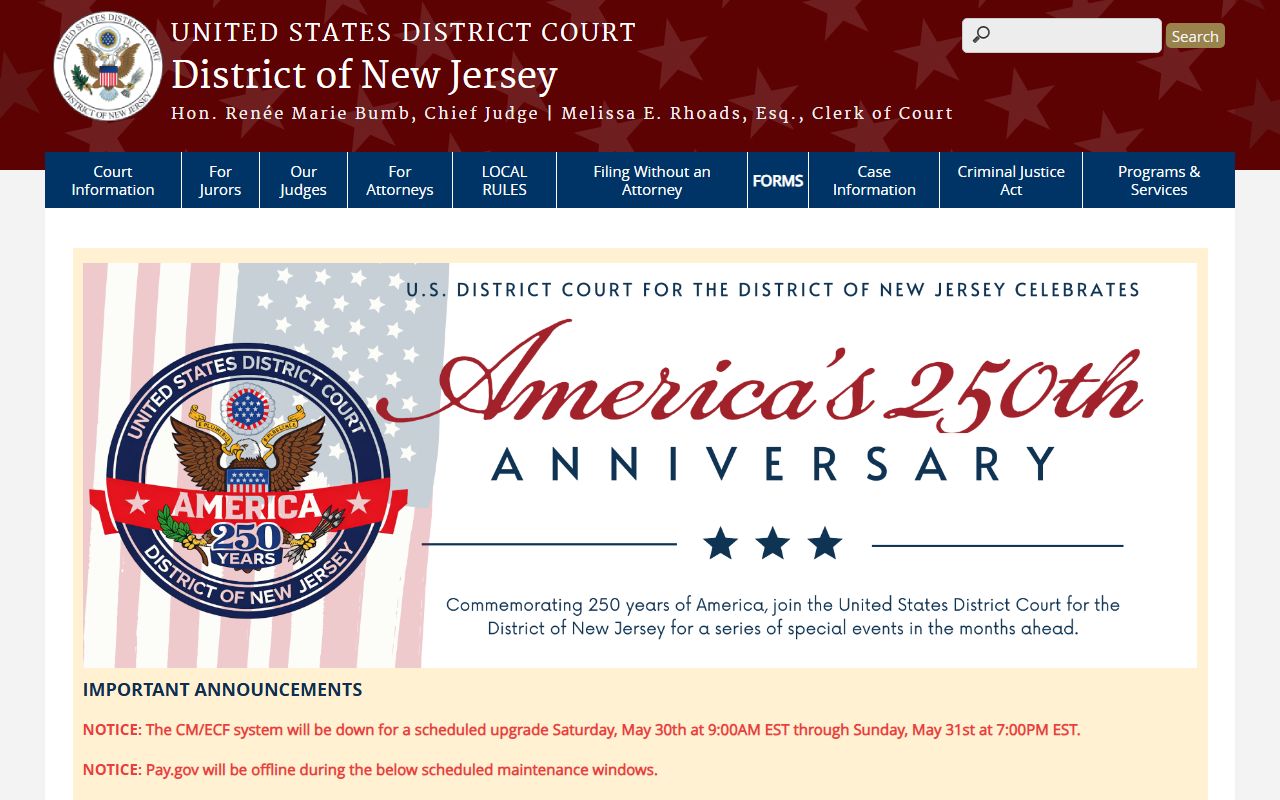
Federal cases searched through PACER include filings, dockets, opinions, and orders from the District Court. Cases from Ocean County appear in the District of New Jersey's docket along with all other New Jersey counties, so a party name or case number search on PACER will return results from any NJ courthouse.
The U.S. Bankruptcy Court for the District of New Jersey handles all federal bankruptcy filings, including those from Ocean County. Bankruptcy is a federal matter; it is not handled by the Ocean County Surrogate's Court or the Superior Court. The Bankruptcy Court has a Trenton location at the same Clarkson S. Fisher U.S. Courthouse, with business hours Monday through Friday, 9 a.m. to 4 p.m., and a drop box available Monday through Friday, 8:30 a.m. to 6 p.m. The screenshot below shows the Bankruptcy Court site, which has case search links, local rules, and fee schedules.
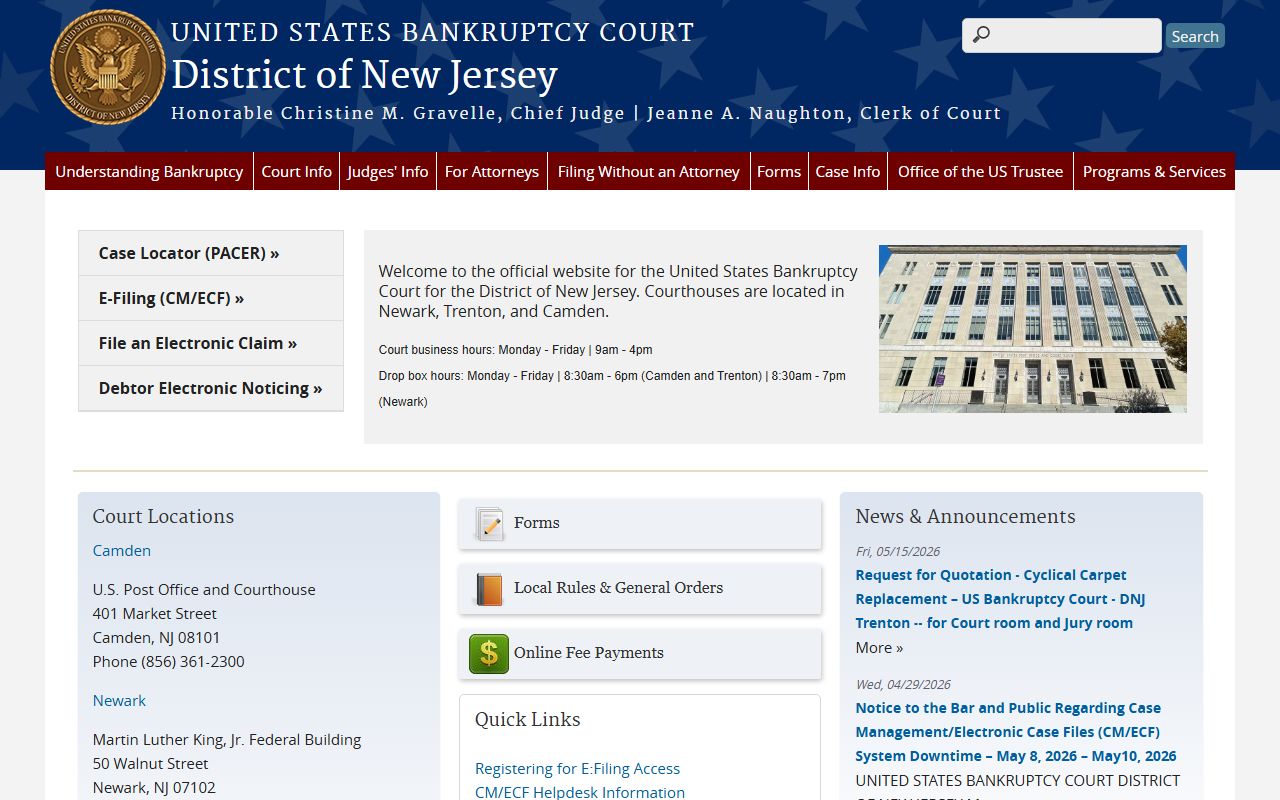
Federal bankruptcy cases involving Ocean County residents are searched through PACER's CM-ECF system the same way other federal civil cases are. Chapter 7, Chapter 11, Chapter 13, and adversary proceedings all appear in the same docket system.
Appeals from federal trial decisions in New Jersey go to the U.S. Court of Appeals for the Third Circuit, which covers New Jersey, Pennsylvania, Delaware, and the U.S. Virgin Islands. If a District Court or Bankruptcy Court ruling from Ocean County is challenged on appeal, the Third Circuit handles it. The screenshot below shows the Third Circuit's official site, which has opinions, oral argument schedules, and filing guidance.
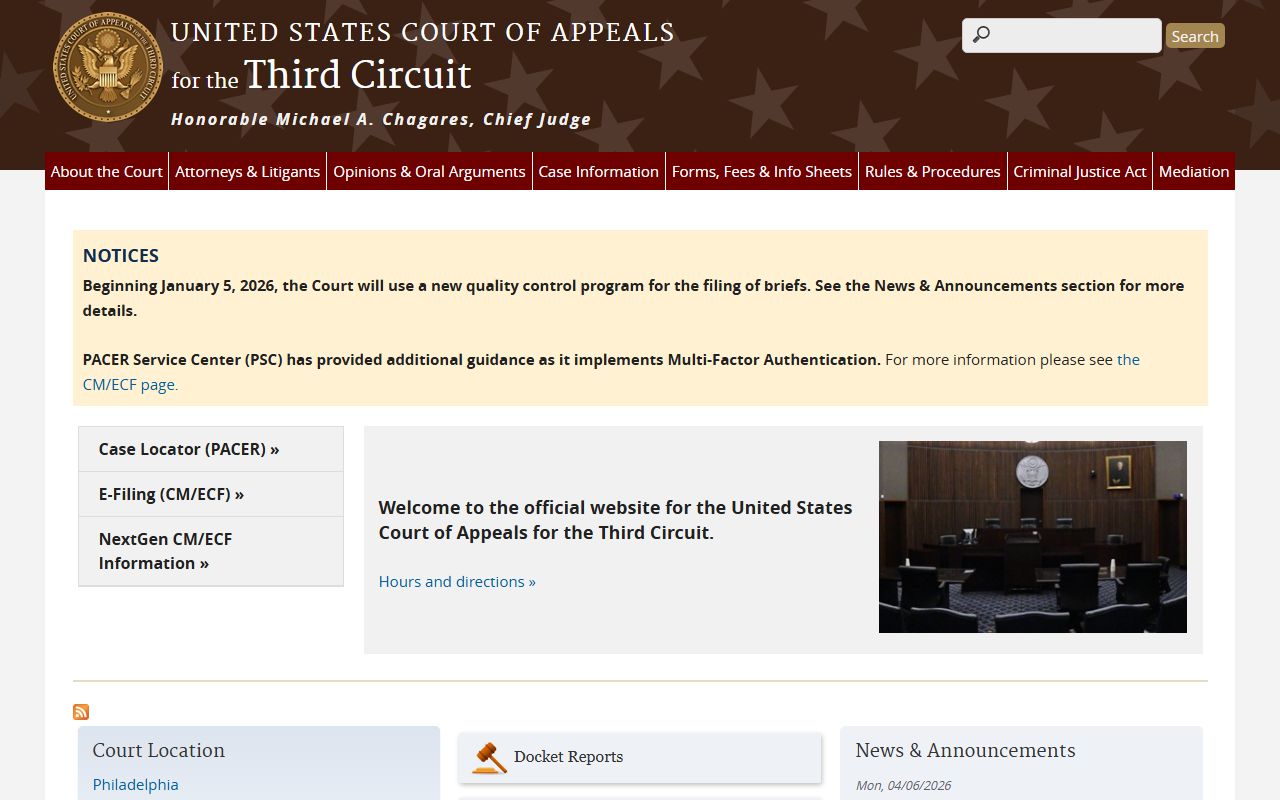
Third Circuit opinions are also available through free platforms such as CourtListener, which indexes federal court opinions through its RECAP project. The screenshot below shows the CourtListener site.
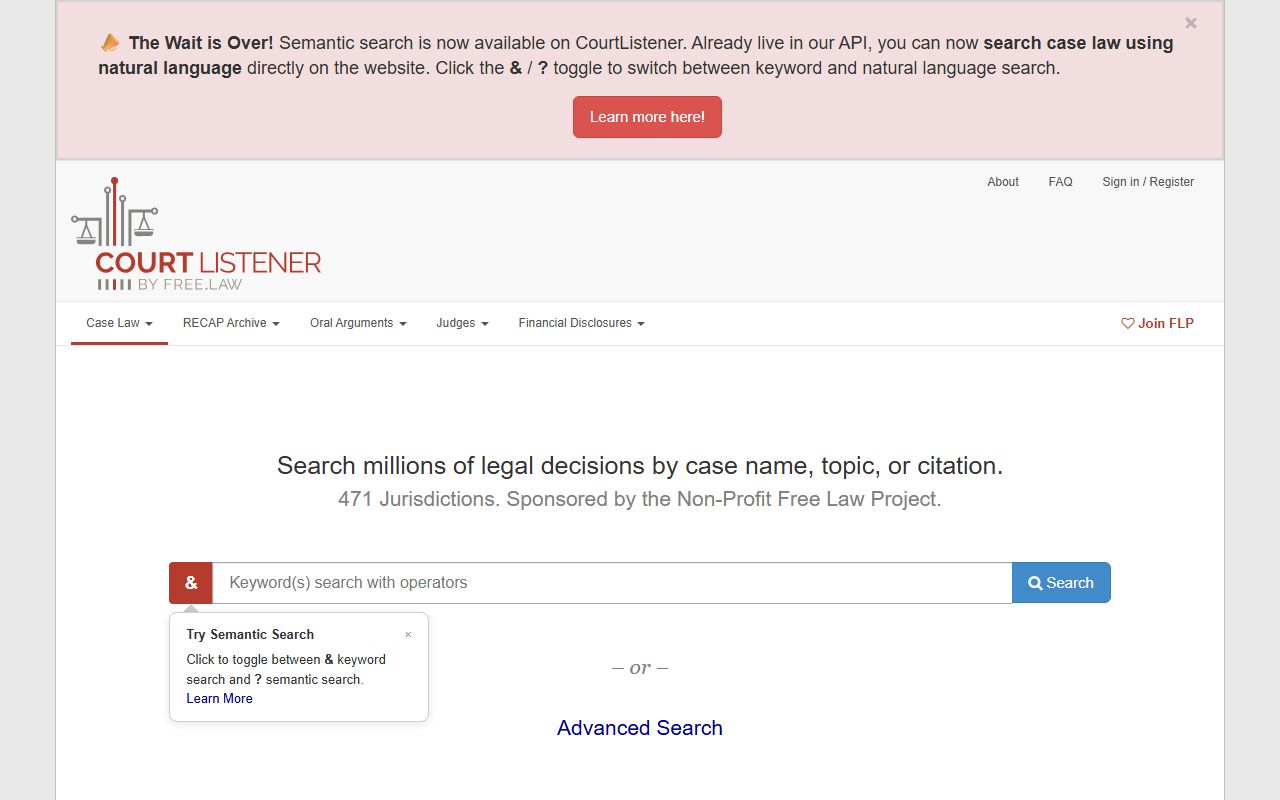
CourtListener is a free way to read District of New Jersey and Third Circuit opinions that touch Ocean County without a paid PACER account.
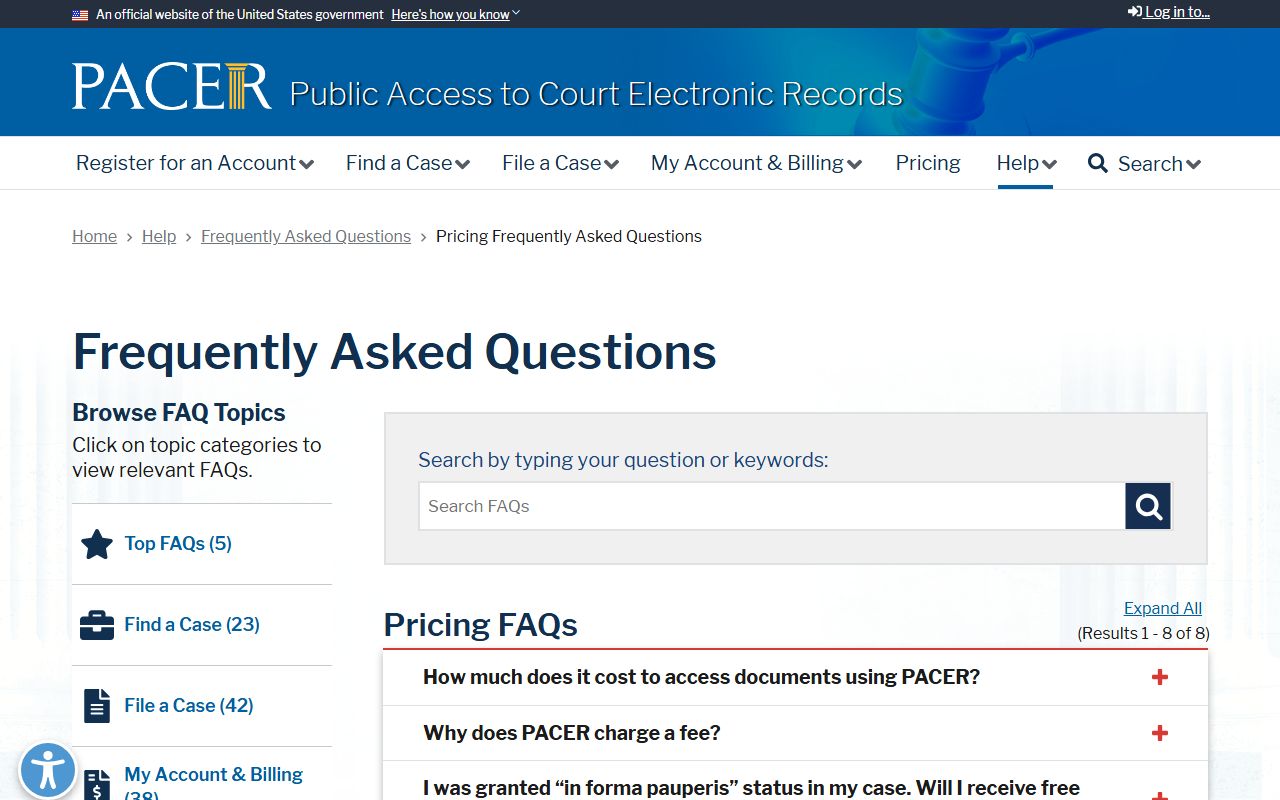
PACER is the main access tool for all federal court records. The PACER pricing page shows that access costs $0.10 per page. If charges for a quarter total $30 or less, PACER waives the fees for that period, which means many searches are free for occasional users. PACER covers filings from 1982 to the present for federal inmates through the BOP, and from the District Court's inception onward for civil and criminal cases. The screenshot below shows the PACER pricing FAQ.
PACER accounts are free to create and give access to the full federal case system, including the District of New Jersey, the Bankruptcy Court, and Third Circuit opinions. For federal criminal cases, the U.S. Attorney's Office for the District of New Jersey, reachable at justice.gov/usao-nj, handles prosecution statewide from Newark, Trenton, and Camden offices. The screenshot below shows the U.S. Attorney's Office site.
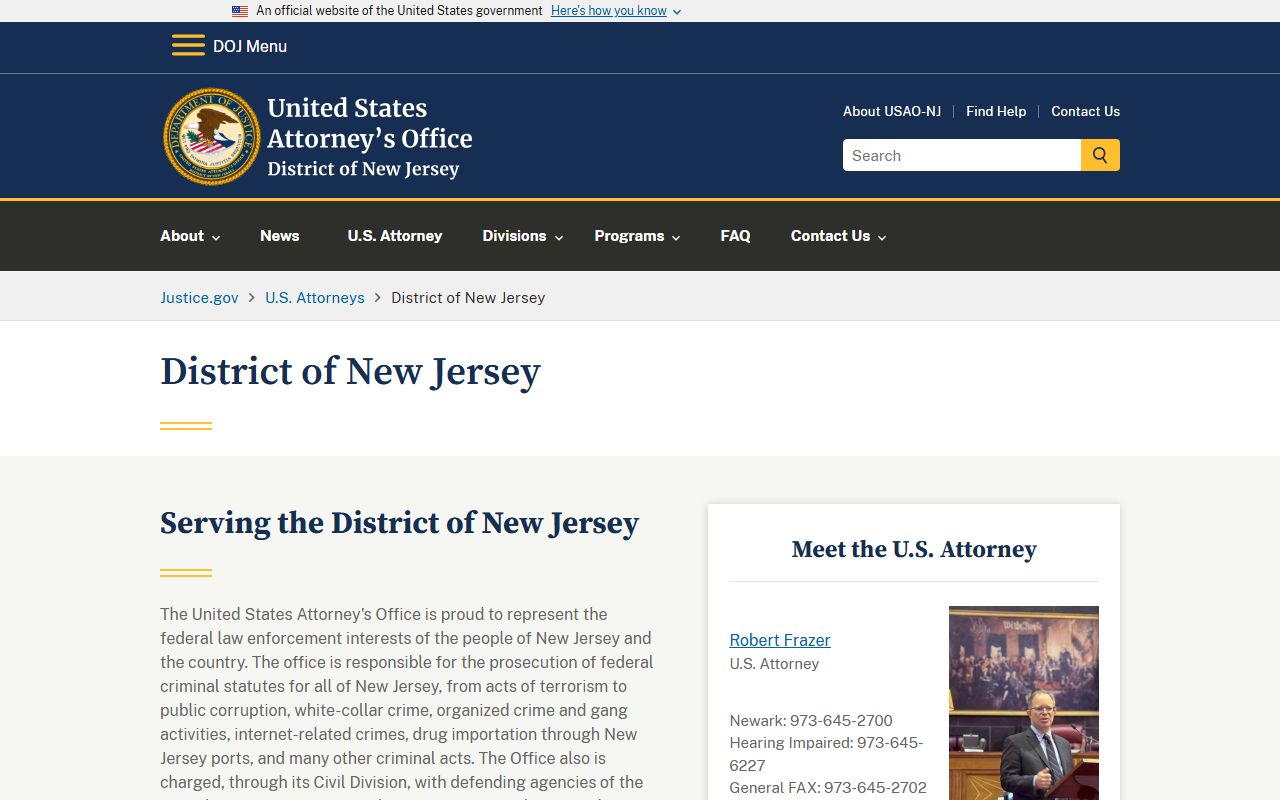
That office prosecutes the federal cases that arise in Ocean County, while the court files themselves stay in the District Court and PACER.